
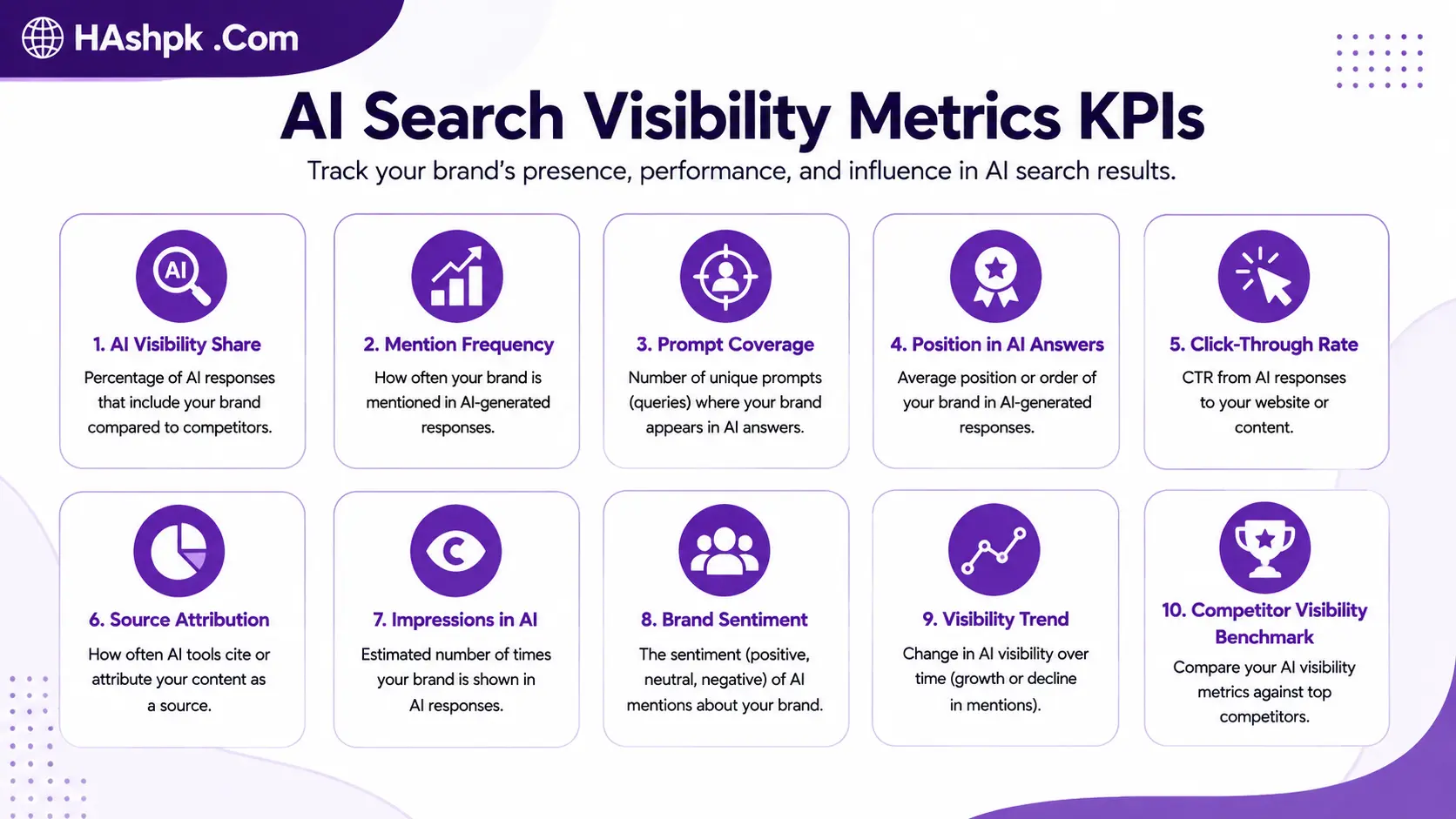
Your dashboard hides more than it shows. These 15 AI search visibility metrics KPIs catch what it misses, plus a full 2026 tracking framework inside. Your Google Search Console dashboard can show a perfect ranking and still be lying to you about how visible your brand actually is. That’s the uncomfortable truth teams are running into as ChatGPT, Perplexity, Gemini, and Google’s AI Overviews increasingly answer questions directly, without a single click landing on your site.
AI search visibility metrics KPIs exist to close that gap ,they measure whether your brand actually shows up inside AI-generated answers, how prominently, how accurately, and whether any of that translates into real pipeline. This guide breaks down the metrics that matter, how they fit together, and how to start tracking them without drowning in vanity numbers.
Why Your Existing Analytics Can’t See Any of This
Rankings and impressions were built for a world where a person searched, scanned a list of blue links, and clicked one. AI search increasingly skips that entire sequence. A user asks a question, gets a synthesized answer, and never visits a website at all — a pattern generally called a zero-click experience.
That creates a second, subtler problem: dark attribution. Someone discovers a brand through an AI answer, then Googles the brand name directly a few days later, or types the URL straight into their browser. Standard analytics credits that visit to “direct” or “organic,” and the AI platform that actually drove the discovery gets zero credit in the report. The influence was real. The dashboard just can’t see it.
Ranking #1 on Google also no longer guarantees inclusion in an AI answer. These systems pull from multiple sources, synthesize several entities into one response, and can vary what they return between one session and the next. That’s exactly why a dedicated measurement layer for AI visibility has become necessary rather than optional.
What AI Search Visibility Metrics KPIs Actually Measure

At the core, this measurement layer tracks four things: whether your brand appears in AI-generated answers, how prominently it’s positioned when it does, how accurately and favorably it’s described, and whether any of that activity connects back to real business outcomes.
These metrics don’t replace your existing marketing or sales KPIs. They function more like an early-warning layer sitting underneath them, a way to catch a visibility problem months before it shows up as a soft quarter in the pipeline numbers.
| Metric Category | What It Tells You | Typical Data Source |
| Presence | Do you show up in AI answers at all, and how often? | Repeated prompt sampling across platforms |
| Prominence | How high up, and how favorably, are you positioned? | Position and ranking within the response |
| Perception | Is the description accurate and positively framed? | Sentiment and fact-checking of AI output |
| Performance | Does visibility connect to conversions or revenue? | Self-reported attribution, branded search lift |
The Core Metrics Worth Actually Tracking
Most teams either track nothing here, or they track everything at once and drown in noise. The metrics below cover the ground that actually matters, grouped by what question each one answers.
Presence Metrics: Are You Even in the Conversation?
Visibility rate is the most basic starting point — the percentage of relevant AI prompts where your brand gets mentioned at all. A brand appearing in 40% of category-relevant prompts and a competitor appearing in 15% tells you exactly where the current battle stands.
Citation share takes that a step further by normalizing it against the whole competitive field: (your brand’s citations ÷ total citations across the category) × 100. A brand earning 250 citations in a category generating 1,000 total citations holds a 25% citation share, a far more useful number than a raw citation count on its own, since raw counts vary wildly by how aggressively different AI engines cite sources.
Prompt coverage rounds this group out by checking breadth rather than depth: are you visible across awareness, comparison, and decision-stage questions, or only in one narrow cluster? A brand that dominates a handful of optimized queries but goes completely dark on comparison prompts has a structural gap competitors will eventually find and exploit.
Prominence Metrics: How Good Is Your Placement?
Being mentioned tenth in a list barely registers with a reader. Being mentioned first, or being the option an AI explicitly recommends, carries a completely different weight. Prominence scoring captures that distinction directly.
| Prominence Level | Description | Relative Influence |
| Top recommendation | Named as the best or leading option | Highest — directly shapes buyer decision |
| Positive supporting mention | Included favorably among several options | Moderate — builds familiarity, not dominance |
| Passive or neutral mention | Listed without clear endorsement | Low — registers as background noise |
| Negative or unfavorable mention | Framed critically or unfavorably | Actively harmful if left uncorrected |
Tracking average prominence across a prompt set — not just a single lucky result — reveals whether your presence is actually influencing decisions or just quietly existing in the background of AI answers nobody weights heavily.
Perception Metrics: What Is AI Actually Saying About You?
This is the category most teams skip entirely, and it’s arguably the riskiest one to ignore. Language models can describe outdated pricing, misattribute a competitor’s feature to your product, or repeat a negative claim that’s been factually wrong for two years. None of that shows up in a visibility percentage or a citation count.
A basic perception audit checks for factual accuracy (is the description of your product current and correct), sentiment (is the framing positive, neutral, or negative), and source quality (is the AI pulling from credible pages or from a low-quality review site with questionable content). Visibility without accuracy isn’t really an asset — a brand mentioned constantly but described incorrectly can lose more trust than a brand barely mentioned at all.
Performance Metrics: Does Any of This Touch Revenue?
Visibility, prominence, and perception all matter, but leadership eventually asks the same blunt question every time: so what did it do for the business? Performance metrics exist to answer that.
Since AI search rarely produces a trackable click, the most reliable method right now is self-reported attribution — asking new customers directly, either at signup or during onboarding, how they found you, and specifically whether an AI tool was involved. Pairing that with branded search lift (a rise in people searching your brand name directly after AI mentions increase) gives a reasonably solid, if imperfect, picture of business impact.
A Simple Framework for Organizing These KPIs
Trying to track every metric above in isolation gets overwhelming fast. Organizing them into layers makes the whole system easier to report on and easier to act on.
| Layer | Core Question | Metrics Involved |
| Discovery Layer | Do you show up at all, and how widely? | Visibility rate, citation share, prompt coverage |
| Authority Layer | How well are you positioned when you do show up? | Prominence score, average position |
| Trust Layer | Is what’s being said about you accurate and positive? | Sentiment analysis, factual accuracy checks |
| Outcome Layer | Is any of this connecting to real business results? | Self-reported attribution, branded search lift |
Most measurement failures happen at the boundary between layers — a brand with strong Discovery Layer numbers and a completely unmonitored Trust Layer, for instance, can be highly visible and quietly losing credibility with every mention. Reporting all four layers together, rather than cherry-picking the one that looks best, is what actually makes this framework useful to a marketing leadership team.
Traditional SEO Metrics vs. AI Search Visibility Metrics KPIs
It helps to see the contrast side by side, since the instinct to reuse an old SEO dashboard for AI reporting is understandable but usually misleading.
| Factor | Traditional SEO Metrics | AI Visibility Metrics & KPIs |
| Core unit measured | Ranking position, clicks, impressions | Citations, mentions, sentiment inside AI answers |
| User behavior assumed | Click-through to a website | Often zero-click; answer delivered directly |
| Attribution method | Click tracking, UTM parameters | Self-reported attribution, branded search lift |
| Consistency of results | Relatively stable day to day | Probabilistic — varies across sessions and platforms |
| Reporting approach | Single-point ranking snapshots | Distributions and trends across repeated sampling |
That last row matters more than it looks. Because AI answers are generated probabilistically, running one query once and calling the result “your visibility score” is closer to guessing than measuring. A more defensible approach samples the same prompt cluster repeatedly across sessions and reports the range of outcomes, not a single number pulled from one lucky or unlucky run.
Which AI Platforms Actually Need Separate Tracking
Visibility on one AI platform doesn’t transfer automatically to another, since each system pulls from different sources and weighs them differently.
- ChatGPT — heavily influenced by training data plus real-time browsing on paid tiers
- Google AI Overviews / AI Mode — closely tied to existing organic search signals and structured data
- Perplexity — leans heavily on real-time web sources and tends to cite more explicitly
- Gemini — integrated with Google’s broader index and knowledge graph
- Claude — draws on both training knowledge and, increasingly, live search when enabled
A brand cited prominently on one of these can be entirely absent on another, which is exactly why cross-platform tracking, rather than checking a single tool and calling it done, is non-negotiable for an accurate picture.
How to Actually Start Measuring This
Getting a working measurement setup off the ground doesn’t require an enterprise platform on day one, though scale eventually pushes most teams toward one.
Start by mapping a realistic set of prompts your actual buyers would ask across the funnel — informational, comparison, and decision-stage questions — rather than a handful of vanity searches with your brand name already in them. Run each prompt cluster across the AI platforms your audience actually uses, repeating the sampling over time rather than relying on a single snapshot. From there, layer in a lightweight sentiment check on anything cited, and add a simple attribution question to your signup or onboarding flow so revenue impact isn’t a total black box.
None of that requires a big budget to begin. It does require discipline — the same discipline that separates a team that can defend its AI visibility numbers in a leadership meeting from one that’s just eyeballing a single ChatGPT response and calling it a report.
15 Advanced AI Visibility Metrics Worth Tracking
| # | Metric | What It Catches | Why It Gets Missed |
| 1 | Answer Inclusion Rate | Model saw your page, still left you out of the actual answer | Being crawled feels like a win, isn’t the same thing |
| 2 | Source Citation Depth | Same one page getting quoted over and over | One page carrying everyone else’s weight, and nobody notices |
| 3 | Query Fan-out Coverage | Whether you show up in the sub-questions the model asks itself | Nobody looks past the one question they typed |
| 4 | First-Mention Rate | How often you’re named first, not third or fourth | Cited feels good until you check where in line you are |
| 5 | Multi-Turn Persistence | Still showing up by question two or three | Almost nobody bothers asking a follow-up to check |
| 6 | Cross-Model Consistency Score | Gap between how ChatGPT vs. Gemini sees you | Averaging platforms hides exactly where you’ve disappeared |
| 7 | Negative-Context Avoidance | Staying out of “scam” or “avoid” style prompts | Everyone watches for presence, forgets the wrong kind of it |
| 8 | Entity Co-occurrence Rate | Which rival keeps getting mentioned next to you | Tells you who the model thinks your competitor is, like it or not |
| 9 | Structured Data Pickup Rate | Whether your schema actually changes the output | Box gets checked, nobody checks if it worked |
| 10 | Answer Freshness Lag | Old, corrected info still floating around in answers | Site gets updated, AI’s memory doesn’t get the memo |
| 11 | Conversational Query Visibility | Visibility when people phrase things how they’d actually talk | Prompt lists still read like keywords, not speech |
| 12 | Follow-Up Trigger Rate | Whether the answer nudges the next question your way | Invisible unless someone reads past the first reply |
| 13 | Snippet Extraction Accuracy | AI quoting your real number, not a mangled one | Wrong figure spreads for weeks before anyone traces it |
| 14 | Category Definition Ownership | AI using your own words to explain the category | Clearest sign you’re steering, not just riding along |
| 15 | AI-Referred Session Depth | Whether AI-sent visitors actually stick around | Traffic looks fine until someone checks what happens next |
Common Mistakes Teams Make Tracking This
A handful of mistakes show up constantly once teams start building out this measurement layer:
- Treating a single AI query as a definitive result instead of one sample among many
- Tracking only branded prompts and ignoring category or comparison queries entirely
- Measuring presence while completely ignoring sentiment and factual accuracy
- Reporting AI visibility in isolation, disconnected from any revenue or pipeline signal
- Assuming visibility on one platform means visibility everywhere else
That last mistake is probably the most common, and the most avoidable — checking ChatGPT alone and extrapolating to “our AI visibility” ignores that Perplexity, Gemini, and Google AI Overviews are pulling from different sources entirely.
Final Thoughts
Treating AI search visibility metrics KPIs as a single dashboard number misses the point entirely. The real value comes from tracking presence, prominence, perception, and performance together, and being honest that the underlying data is probabilistic rather than fixed, a trend built from repeated sampling, not a score pulled from one lucky query.
The teams that will be ahead a year from now aren’t the ones with the fanciest tracking tool. They’re the ones who started measuring this layer early, stayed consistent about it, and connected what they found back to actual pipeline instead of treating a citation count as an end in itself.
FAQs
What are AI search visibility metrics KPIs, in simple terms?
They’re the measurements that show whether, how often, and how favorably your brand appears inside AI-generated answers on platforms like ChatGPT, Gemini, and Google AI Overviews — as opposed to traditional metrics that track clicks and rankings on a search results page.
Why can’t I just use my existing SEO dashboard for this?
Because AI search often produces zero-click experiences and dark attribution, where a user discovers your brand through AI but converts later through a channel that gets all the credit instead. Standard analytics tools weren’t built to capture that path.
How often should AI visibility be measured?
Repeatedly and consistently, not as a one-time check. Because AI outputs vary across sessions, a single query is a sample, not a fact — regular, repeated sampling over weeks builds a trend you can actually trust.
Does a high visibility score always mean good news?
Not necessarily. A brand can be mentioned frequently while being described inaccurately or unfavorably, which is why sentiment and accuracy checks matter just as much as raw visibility percentage.
Can AI search visibility actually be tied to revenue?
Yes, though imperfectly. Self-reported attribution at signup, combined with tracking branded search lift after visibility increases, is currently the most practical way to connect AI presence to real business outcomes.


