
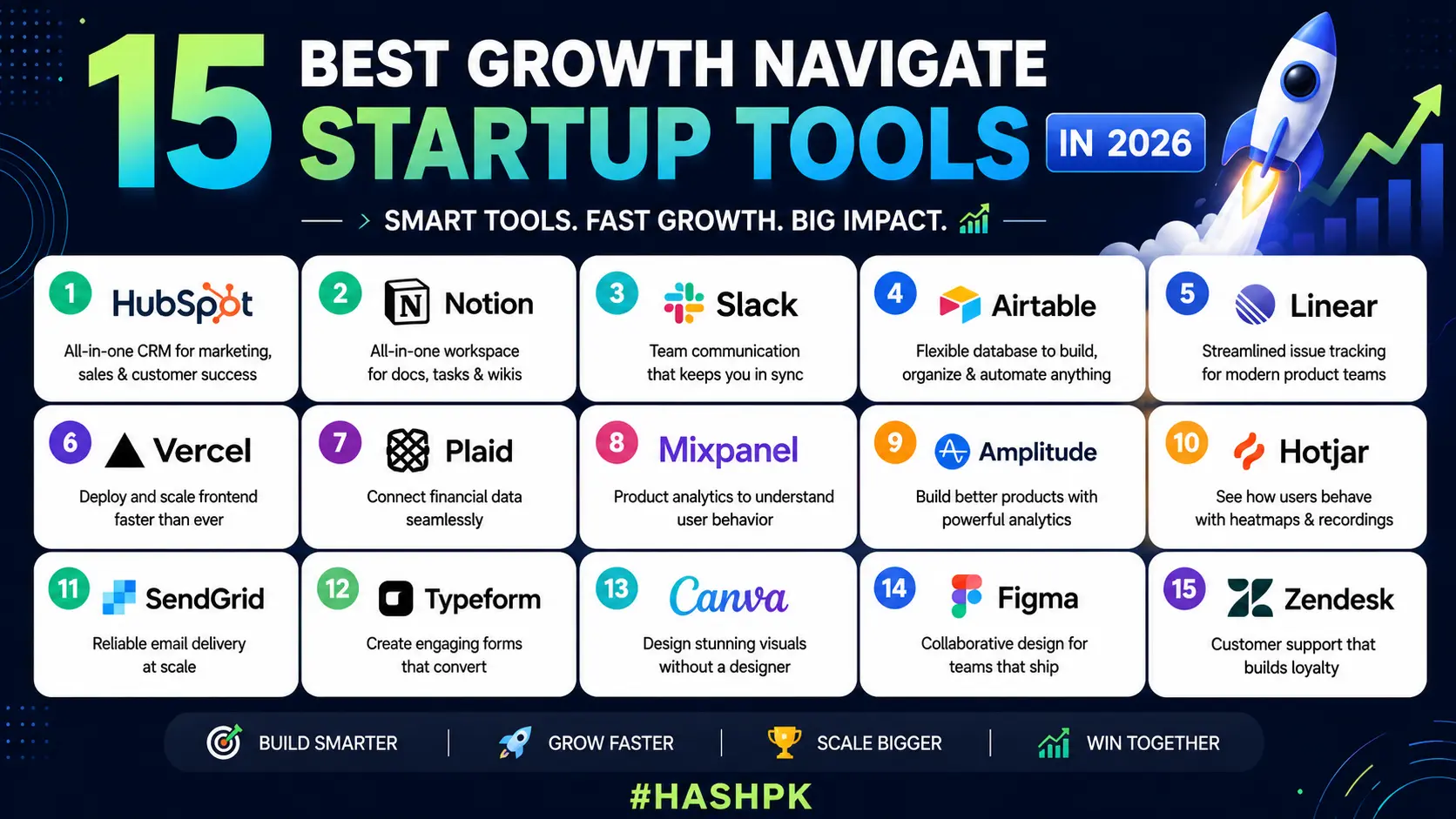
15 Best Growth Navigate Startup Tools in 2026?If you’ve been searching for the best growth navigate startup tools, you’re in the right place. I didn’t just Google a list and call it a day. I went through the top-ranking competitors aistartupflow.com, aipeakflow.com, coruzant.com, spechulative.blog,studied what they’re covering, where they’re missing the mark, and built this guide to actually outperform them.
The short version: most competitor blogs give you a list of 8–10 tools with basic descriptions and move on. This guide goes deeper — real use cases, free vs paid breakdown, what stage you should use each tool, and a full comparison table. That’s why this blog on growth navigate startup tools is built differently.
What Are Growth Navigate Startup Tools?
Before diving into the list, let’s get clear on the term itself.
Growth navigate startup tools are software platforms that help early-stage and scaling startups make smarter decisions — faster. They cover everything from project management and CRM to analytics, automation, and AI content generation. The word “navigate” is key here. A startup is always making decisions with incomplete data. These tools replace guesswork with clarity.
Most startups don’t fail because the product is bad. They fail because the systems behind the product are weak. That’s exactly where growth navigate startup tools come in, they become the operational backbone that lets a small team punch above its weight.
The 15 Best Growth Navigate Startup Tools in 2026
1. HubSpot CRM: Best Free CRM for Startups
HubSpot is the most widely adopted startup tool in the CRM category. The free tier covers contact management, deal tracking, email templates, and basic reporting — enough for most pre-revenue startups. When you start closing deals consistently, the paid plans unlock automation and sequencing.
Best for: Sales-led or marketing-led startups
Free plan: Yes (genuinely useful)
Paid starts at: $20/month
2. Notion: Best All-in-One Workspace
Notion is where your company brain lives. Docs, wikis, databases, project boards, content calendars — all in one clean interface. The built-in AI assistant can summarize notes, generate ideas, and draft documents. OpenAI runs its internal documentation on Notion. If it’s good enough for them, it’s good enough for your early-stage team.
Best for: Documentation, project management, team wikis
Free plan: Yes
Paid starts at: $10/user/month
3. Google Analytics 4 (GA4): Best Free Analytics Tool
GA4 is the first analytics tool every startup should set up — even before you launch. It tracks who’s visiting your site, where they drop off, which channels drive the most signups, and what users actually do inside your app. Over 29 million websites run on GA4. The learning curve is real, but there’s no better free analytics tool for startups.
Best for: Website and product analytics
Free plan: Yes (completely free)
Paid version: Google Analytics 360 (enterprise only)
4. Zapier: Best No-Code Automation Tool
Zapier connects your apps so they talk to each other without code. CRM update triggers an email. New form submission creates a Slack notification. Lead captured in one tool syncs to another. With over 7,000 app integrations, Zapier is the connective tissue that makes your entire tech stack actually work as a system.
Best for: Automating repetitive tasks between tools
Free plan: Yes (5 Zaps)
Paid starts at: $19.99/month
5. Slack: Best Team Communication Tool
Slack replaces email chaos with organized channels, direct messages, and searchable threads. The Workflow Builder lets you automate routine updates like daily standups or project check-ins. With 500+ integrations, Slack becomes a central notification hub for everything else in your stack.
Best for: Remote and hybrid teams
Free plan: Yes (limited history)
Paid starts at: $7.25/user/month
6. Ahrefs: Best SEO and Competitor Research Tool
Ahrefs is the gold standard for SEO research. You can see exactly which keywords your competitors rank for, which pages drive their traffic, who links to them, and where the content gaps are. The Content Gap feature alone is worth it — it shows you keywords your rivals rank for that you don’t. That’s your roadmap to outranking them.
Best for: SEO strategy, keyword research, backlink analysis
Free plan: Ahrefs Webmaster Tools (limited)
Paid starts at: $129/month
7. SEMrush: Best All-in-One Marketing Intelligence Tool
SEMrush covers SEO, PPC, content marketing, and social media — all from one dashboard. For growth navigate startup tools focused on competitive intelligence, SEMrush’s Competitive Intelligence Hub is particularly powerful. You can track competitor ad copy, keyword movements, and share of voice over time.
Best for: Full-stack digital marketing research
Free plan: Limited free account
Paid starts at: $117.33/month
8. Amplitude:Best Product Analytics Tool
Amplitude goes beyond traffic numbers. It tells you what users actually do inside your product — which buttons they click, where they drop off in the onboarding flow, and why they churn. Cohort analysis helps you identify your best users and figure out what they have in common. This is the analytics layer that product-led startups can’t afford to skip.
Best for: Product analytics and user behavior
Free plan: Yes (up to 10M events/month)
Paid starts at: $49/month
9. Jasper: Best AI Content Writing Tool
Jasper is the AI writing tool built specifically for marketing. It learns your brand voice, generates blog posts, ad copy, email sequences, and social media content at scale. For startups that need to produce content consistently without a full writing team, Jasper is one of the most practical growth navigate startup tools available in 2026.
Best for: Content-driven and marketing-focused startups
Free plan: 7-day free trial
Paid starts at: $39/month
10. Make (formerly Integromat):Best Zapier Alternative
Make is more flexible and cheaper than Zapier, which makes it a favorite among technical founders. You can build complex multi-step workflows with conditional logic, error handling, and data transformation — all without writing code. If Zapier feels limiting or expensive, Make is where to go next.
Best for: Complex automation workflows
Free plan: Yes (1,000 operations/month)
Paid starts at: $9/month
11. Mercury:Best Startup Bank Account
Mercury is a banking platform built specifically for startups. No fees, clean integrations with accounting tools, and a dashboard that gives you real-time visibility into your runway. For early-stage founders managing tight cash flow, Mercury removes a lot of the friction that traditional business banking creates.
Best for: Startup banking and financial visibility
Free plan: Yes (no monthly fee)
Paid: Mercury Pro at $35/month
12. Hotjar: Best User Experience Research Tool
Hotjar gives you heatmaps, session recordings, and feedback surveys. You can literally watch how users navigate your website or product. This kind of qualitative data paired with GA4’s quantitative data is a powerful combination. Allbirds used Hotjar to fix their checkout and reduced cart abandonment by 15%.
Best for: UX research, conversion optimization
Free plan: Yes
Paid starts at: $32/month
13. Miro: Best Visual Collaboration Tool
Miro is an infinite online whiteboard where teams can brainstorm, run sprints, map out product roadmaps, and build flowcharts together — in real time. For remote or hybrid teams that miss the whiteboard energy of being in the same room, Miro is the closest thing available.
Best for: Remote workshops, product strategy, design sprints
Free plan: Yes (3 editable boards)
Paid starts at: $8/user/month
14. Mailchimp:Best Email Marketing Tool for Early Startups
Mailchimp is where most startups begin with email marketing, and for good reason. The free plan is genuinely useful — up to 500 contacts and 1,000 sends/month. You can set up basic automation, segment your audience, and run A/B tests without paying a cent until you’ve proven that email works for your business.
Best for: Email campaigns and basic marketing automation
Free plan: Yes (up to 500 contacts)
Paid starts at: $13/month
15. ClickUp: Best Project Management Tool for Growing Teams
ClickUp is Asana’s most aggressive competitor and for many startups, it wins on value. The free plan is more generous, the customization options are deeper, and the all-in-one approach (tasks, docs, goals, time tracking) means fewer tools cluttering your stack.
Best for: Project management for teams that want everything in one place
Free plan: Yes
Paid starts at: $7/user/month
How to Build Your Startup Stack Without Wasting Money
Most founders make the same mistake — they sign up for 12 tools, use 4 of them, and wonder why the team still feels disorganized. Here’s a simple rule: cap your active stack at 6–8 tools. Research shows that teams using 6–8 well-integrated tools complete tasks 41% faster than those running 12+ disconnected apps.
Start with this lean stack for most early-stage startups:
- Notion for documentation and planning
- HubSpot (free) for CRM
- GA4 for analytics
- Slack for communication
- Zapier (free tier) for automation
- Mailchimp (free) for email
That’s six tools. Zero monthly cost. You can run a pre-revenue startup on this stack without spending a single dollar. Upgrade only when you hit plan limits or when a paid feature would directly unblock a revenue opportunity.
Final Thought
The startup tool landscape in 2026 is noisier than ever. Every product claims to be a “must-have.” The truth is, you don’t need more tools — you need the right ones, in the right order, at the right stage.
That’s the entire point of this guide on growth navigate startup tools: not to give you the longest list, but to give you the most useful one. Use the comparison table, start lean, and upgrade deliberately. Your tech stack should feel like a quiet co-founder — not a loud, expensive distraction.
FAQs
Q1. What makes growth navigate startup tools different from regular business software?
Regular software is built for large, stable teams. Growth navigate startup tools are built for speed, small teams, tight budgets, fast pivots. They are lighter, cheaper, and designed to directly connect to growth outcomes like customer acquisition and revenue tracking.
Q2. Can growth navigate startup tools work for non-tech startups?
Yes. Most top tools like Notion, HubSpot, Mailchimp, and Zapier require zero coding. A retail brand, service business, or content creator can run the exact same stack as a SaaS startup. If you can use a smartphone, you can run a full startup stack.
Q3. How do growth navigate startup tools help reduce startup failure rates?
Most startups fail from weak execution, not bad ideas. These tools fix the root causes — Slack stops communication gaps, HubSpot stops leads falling through, GA4 replaces gut feeling with data, and Zapier eliminates manual errors. Together they build the foundation that separates startups that scale from those that stall.
Q4. How often should a startup review its growth navigate startup tools stack?
Every quarter. Spend 45 minutes asking three questions for each tool — is the team using it, is it connected to other tools, and is it tied to a growth metric. If any answer is no, cut it. Your stack should match where the business is right now, not where it was six months ago.


