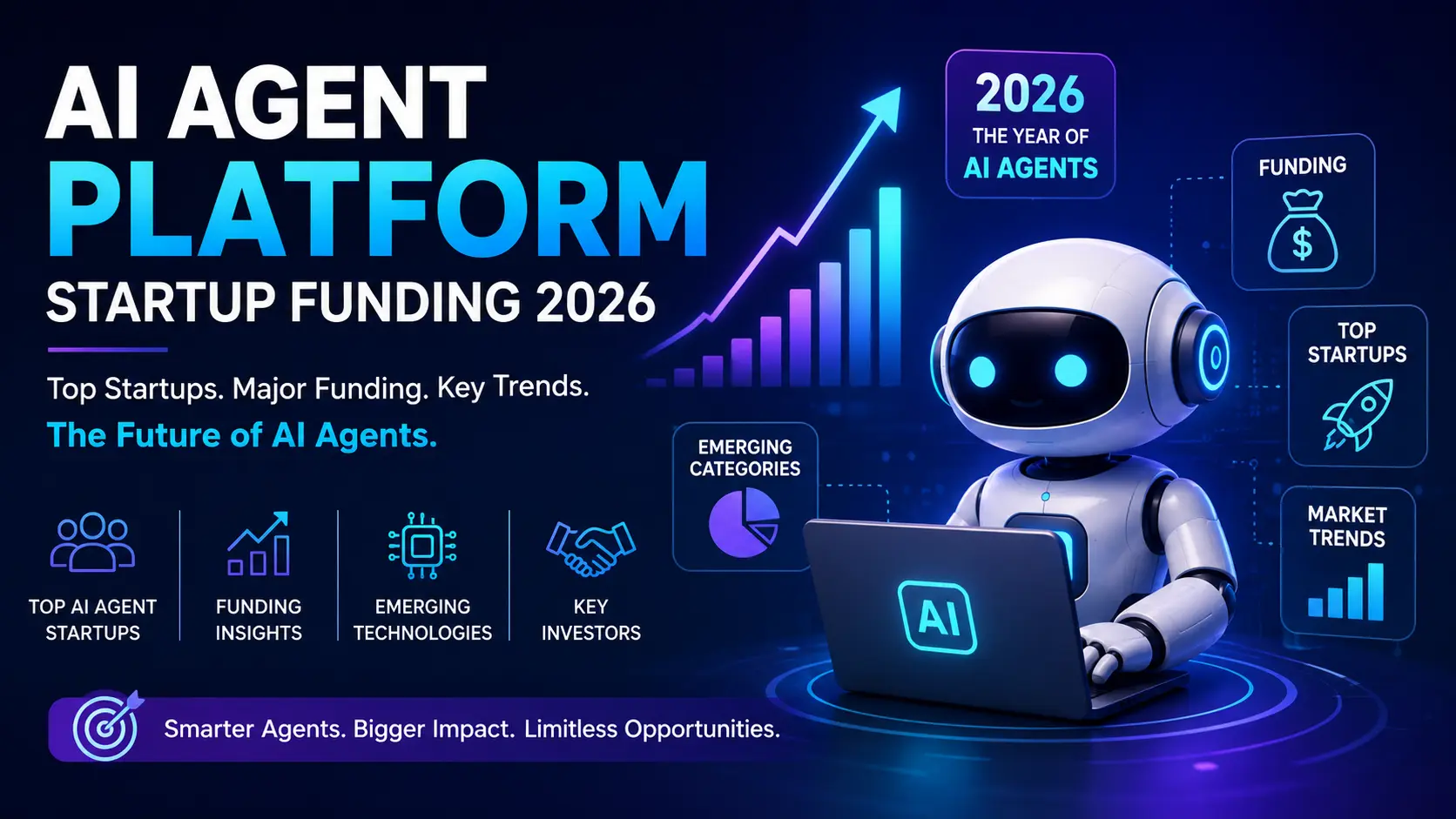
.Every week seems to bring a new nine-figure round for a company nobody had heard of six months earlier. That’s the honest starting point for anyone trying to make sense of AI agent platform startup funding 2026: the headline numbers are real, but most public summaries either inflate them by lumping in unrelated model labs, or they undercount them by only tracking one quarter at a time. This piece pulls the year together, what’s actually closed, who’s writing the checks, which categories are winning, and where the money is quietly drying up.
What is ai agent platform startup funding 2026?
Global venture funding hit a record $510 billion in the first half of 2026, and more than 70% of Q2 capital went to AI companies. Within that, agentic AI startups alone pulled in over $1 billion in H1 2026 — nearly double the $538 million raised in the same window in 2025. By Q3, disclosed agent-specific rounds crossed $1.32 billion across just twenty deals, with average check sizes roughly doubling from July to August. The catch: two companies, OpenAI and Anthropic, absorbed 43% of everything raised across the entire first half, which means the real competition for AI agent platform startup funding 2026 dollars is happening in a much smaller pool than the topline number suggests.
The 2026 funding landscape
Funding for agentic AI remains active, but the standard for raising capital is higher than it was during the first wave of generative AI. A polished demo may attract attention, but enterprise buyers and venture investors now ask harder questions: Can the system operate reliably? Does it integrate with existing tools? Can a company control what the agent sees and does? Does it save money or create revenue?
A market tracker covering Q2 2025 through Q2 2026 recorded 101 disclosed agentic-AI financing rounds totaling $4.69 billion. Q2 2026 was the busiest quarter in that tracker, with 39 deals and nearly $1.30 billion raised
What Actually Counts as an “AI Agent Platform” Startup
Before the numbers, a quick clarification, because this is where most funding trackers get sloppy. An AI agent platform is different from a foundation model lab, a chatbot wrapper, or general AI infrastructure. It’s software that plans, takes actions, and completes multi-step tasks with minimal human supervision — booking a refund, filing a compliance report, running a procurement workflow, negotiating with a vendor. Companies like Fireworks AI (inference), Atoms (physical AI/robotics), or Together AI (cloud compute) get swept into “AI funding” totals constantly, but they’re not agent companies by any reasonable definition. Keeping that line clean is the only way a funding total means anything.
Powering the Next Wave of AI Agent Startups
AI agents are no longer limited to simple chat-based tasks. New startups are building agents that can code, handle customer support, manage business workflows, and solve industry-specific problems with less human input.
Where AI Agents Are Gaining Real Traction
The biggest growth is happening in areas where agents can replace repetitive work and deliver clear business value. Coding, legal services, customer support, procurement, security, and enterprise automation are becoming major parts of the AI agent ecosystem.
Why Agentic Search Is Becoming a New AI Infrastructure Layer?
As AI agents take on more complex tasks, they need fast and reliable access to fresh web information. This is creating demand for search infrastructure built specifically for agents, opening a new opportunity beyond traditional search engines.
The Rise of Agentic Web Search & AI Search Infrastructure
AI agents need fast and reliable access to web information to complete complex tasks. This is creating a new market for agentic search and AI search infrastructure, with startups building search systems designed specifically for machine-driven queries.
AI Agent Market Trends and What’s Next in 2026?
The AI agent market is shifting from simple demos toward products that deliver measurable business results. Funding is becoming more concentrated, while vertical agents, infrastructure, security, and automation are emerging as key areas to watch through the rest of 2026.
The 2026 Numbers, Quarter by Quarter
Q1 2026 set the tone: $305 billion in global VC funding (Crunchbase) or $330.9 billion (KPMG, which counts growth-stage and debt instruments Crunchbase excludes). Either way, it more than doubled the prior quarter.
Q2 2026 kept the concentration pattern going, with Cognition’s Devin coding agent raising over $1 billion at a $26 billion valuation up from $10.2 billion just eight months earlier, on a reported $492 million revenue run-rate.
Q3 2026 (through mid-August) recorded twenty disclosed agent rounds worth roughly $1.32 billion: thirteen rounds in July ($643M) and seven in the first half of August alone ($681.5M). The average check size nearly doubled month-over-month, from about $49 million to $97 million, even as the number of companies raising held roughly steady.
That last point matters more than the topline. It’s not that more startups are getting funded — it’s that the ones clearing the bar are getting funded much harder.
Major AI Agent Funding Rounds of 2026
Here’s a consolidated table pulling together the largest, best-verified rounds across the year. This is where most competing roundups either stop at “top 25 by valuation” (missing the recent momentum) or only track one month at a time. This table does both.
| Company | Round | Amount | Valuation | Category |
| Cognition AI (Devin) | Series C | $1B+ | $26B (in talks at $40B) | Coding agent |
| Sierra | Series C | $350M | $10B | Customer service agents |
| Anysphere (Cursor) | Series B | $2.3B | $29.3B | Coding agent |
| Replit | — | $400M | $9B | App-building agent |
| Glean | Series F | $150M | $7.2B | Enterprise search/knowledge agents |
| Harvey AI | Series E | $300M | $5B | Legal agents |
| HappyRobot | Series C | $150M | $1.2B | Logistics/voice agents |
| CodeRabbit | Series C | $143M | $1.5B | Code review agents |
| Norm AI | Series C | $120M | Undisclosed | Legal/compliance agents |
| Prime Intellect | Series A | $130M | $1B | Agent training infrastructure |
| Acrab | Series B | $130M | Undisclosed | Agentic compute/edge silicon |
| Zenity | Series C | $125M | Undisclosed | Agent governance/security |
| Lyzr | Series B | $100M | ~$500M | Enterprise agent builder |
| Neo Security | Growth | $100M | Undisclosed | Agent access control |
| Obsidian Security | Series D | $85M | Unicorn+ | Non-human identity security |
| Freehand | Series B | $75M | Undisclosed | Procurement agents |
| Act Security | Seed + A | $60M | Undisclosed | Agent access sprawl |
Amounts reflect the raise, not always the full cap table — and every figure above traces back to a primary source (TechCrunch, Bloomberg, Crunchbase News, or the company’s own announcement), not an aggregator’s recycled number.
Top AI agent funding deals
| Company | Reported funding | Category | What the company represents |
| Sierra | $350 million | Customer-service agents | Enterprise agents designed to manage customer interactions and service tasks |
| Parloa | $350 million | Voice AI agents | Enterprise voice automation for contact centers and customer conversations |
| Genspark | $275 million | Agentic workspace | AI-driven systems for completing multi-step knowledge-work tasks |
| Sublime Security | $150 million | Email security | Autonomous detection and response for email threats |
| Wonderful | $150 million | Multilingual support agents | Customer-service automation across languages and channels |
| 8090 | $135 million | Software-building agents | AI-native enterprise software development workflows |
| Decagon | $131 million | Customer-support agents | Automation for complex enterprise support operations |
| 7AI | $130 million | Cybersecurity agents | AI-led investigation and response for security operations |
| LangChain | $125 million | Agent infrastructure | Tools for building, deploying, and monitoring agentic applications |
| Netomi | $110 million | Customer experience | Automated enterprise customer-service operations |
| Basis | $100 million | Accounting agents | AI workflows for finance and accounting teams |
| Core Automation | $100 million | Enterprise automation | Systems for automating operational processes |
Where the Money Is Actually Going Category Breakdown
This is the part most AI agent platform startup funding 2026 coverage skips entirely, and it’s the most useful thing for founders and investors trying to place a bet.
Agent infrastructure (the picks-and-shovels layer)
Prime Intellect’s $130M round is the clearest example, selling compute, reinforcement learning frameworks, and evaluation tooling so enterprises can train their own agents instead of renting someone else’s. This layer is attracting the largest single checks because it sits underneath every vertical agent built on top of it.
Vertical, domain-specific agents
This is where the real ROI story lives. Vertical AI agents are winning bigger rounds than horizontal, general-purpose assistants because they solve one expensive problem completely — legal compliance (Norm AI, Harvey), procurement (Freehand), investment research (LinqAlpha), customer service (Sierra). Investors increasingly want to see named enterprise customers and measurable workflow replacement, not a demo.
Agent governance and security — the fastest-growing new category
This one barely existed as a funded category before mid-2026. In an eleven-day stretch in July, three governance startups (Neo Security, Act Security, Hush Security) raised $190 million combined. Then in August, Zenity and Obsidian Security raised $210 million between them in just 48 hours. The thesis is straightforward: once agents get write-access to real production systems, controlling what they’re allowed to touch becomes as important as the agent itself. Expect this to keep expanding through the rest of the year.
Agent payments infrastructure
A newer, smaller category — startups like Natural and AIsa are building payment rails that let agents transact autonomously (subscribe to a tool, pay a vendor, settle in stablecoins) without a human clicking “approve.” Still early, with no major follow-on rounds as of mid-August, so this one is worth watching rather than betting on yet.
Coding and developer-tooling agents
Cursor, Cognition, Replit, CodeRabbit, and 8090 collectively represent some of the largest checks of the year. Revenue multiples here are extraordinary — Cursor at $500M ARR against a $29.3B valuation is the standout example.
Who’s Writing the Checks?
The investor list repeats across almost every major round, which tells you the pool of capital chasing this category is more concentrated than the deal count suggests:
- Sequoia Capital — Sierra, Harvey, Glean
- Andreessen Horowitz — Hippocratic AI, Neo Security, multiple YC-adjacent rounds
- Benchmark — Sierra, Exa
- Khosla Ventures — Norm AI, Parallel
- Bessemer Venture Partners — Neo Security, Act Security
- Founders Fund — Cognition AI
- Radical Ventures — Prime Intellect (with Nvidia Ventures, Intel Capital, and Dell Technologies Capital co-investing)
- Nexus Venture Partners — Freehand, Naïve
Price Running Ahead of Revenue
The average revenue multiple across the sector sits around 52x ARR, with customer service agents specifically commanding closer to 127x. Cognition is the sharpest example of this pattern: its valuation moved from $10.2 billion to $26 billion in roughly eight months, and reports in August suggested talks for a step up toward $40 billion — a jump justified by revenue nearing $1 billion in run-rate, up from $492 million just months earlier. That’s a genuine doubling in a single quarter, which is the rare case where a steep valuation jump is backed by real numbers rather than sentiment.
Not every company gets that benefit of the doubt. Enterprises are consolidating fast — moving from testing a dozen pilot tools to picking one or two vendors per category — which means startups without clear differentiation or a defensible data/workflow moat are going to struggle to raise their next round regardless of how good the demo looks.
The Bootstrapped Counter-Trend
Here’s a detail most funding roundups leave out entirely: you increasingly don’t need venture capital to build a real AI agent company in 2026. Inference costs keep falling as model providers compete on price, and the tooling to build, deploy, and monitor agents is now off-the-shelf. A small team can ship a working agent product, reach paying customers, and grow without ever raising a round. This matters for anyone reading funding trackers as a proxy for “what’s working” — the visible, funded companies are the loud minority of a much larger, quieter market of profitable agent businesses that simply never show up in a funding table.
What This Means for Founders and Investors
If you’re evaluating AI agent platform startup funding 2026 as a founder trying to raise, or as an investor trying to place capital, three patterns are worth internalizing:
- Thin wrappers don’t get funded anymore. Investors want infrastructure with defensible technical depth, or vertical agents with named enterprise customers and measurable outcomes. A general-purpose assistant with no specific workflow ownership is the hardest pitch in the room right now.
- Governance and security are no longer optional add-ons — they’re becoming their own funded category, and any agent platform selling into the enterprise should expect to be asked about access control, audit trails, and permission scoping in the first meeting.
- Bigger checks, fewer surprises. The market isn’t funding more companies than before — it’s funding the same rough number of companies with roughly double the capital per round, which raises the bar for what “traction” needs to look like before a Series A conversation even starts.
The Bottom Line
AI agent platform startup funding 2026 is defined less by how much total money is flowing and more by where it’s concentrating. The headline figures are massive, but a huge share pools at two model labs, leaving the actual agent-platform layer to compete for a smaller, sharper pool of capital — one that increasingly rewards infrastructure depth, named enterprise revenue, and governance-readiness over demo polish. Vertical agents with real customers, agent-training infrastructure, and the emerging governance/security layer are where 2026’s money is actually landing, and that’s the pattern worth tracking into Q4.
FAQs
How much funding did AI agent startups raise in 2026?
Agentic AI startups raised over $1 billion in the first half of 2026 alone, nearly double the $538 million raised in the same period in 2025. By mid-Q3, disclosed agent-specific rounds had crossed $1.32 billion across twenty deals, not counting mega-rounds at model labs like OpenAI and Anthropic.
What’s the biggest AI agent funding round of 2026?
Cognition AI’s raise stands out — over $1 billion at a $26 billion valuation in Q2, with reports in August of fresh talks toward a $40 billion valuation on nearly $1 billion in annualized revenue.
Which category is attracting the most AI agent investment in 2026?
Vertical, domain-specific agents (legal, procurement, customer service, financial research) are outpacing general-purpose horizontal platforms, because they demonstrate clearer ROI and faster enterprise adoption. Agent governance and security is the fastest-growing new category, having gone from nonexistent to $400M+ funded within a few months.
Do AI agent startups need venture capital to succeed in 2026?
Not necessarily. Falling inference costs and mature tooling let small teams build and monetize agent products without raising, and a meaningful share of the market is bootstrapped and profitable outside the funding headlines.
Who are the most active investors in AI agent platforms?
Sequoia Capital, Andreessen Horowitz, Benchmark, Khosla Ventures, Bessemer Venture Partners, and Founders Fund appear across the largest rounds of the year, alongside corporate strategics like Nvidia Ventures, Intel Capital, and Dell Technologies Capital.