
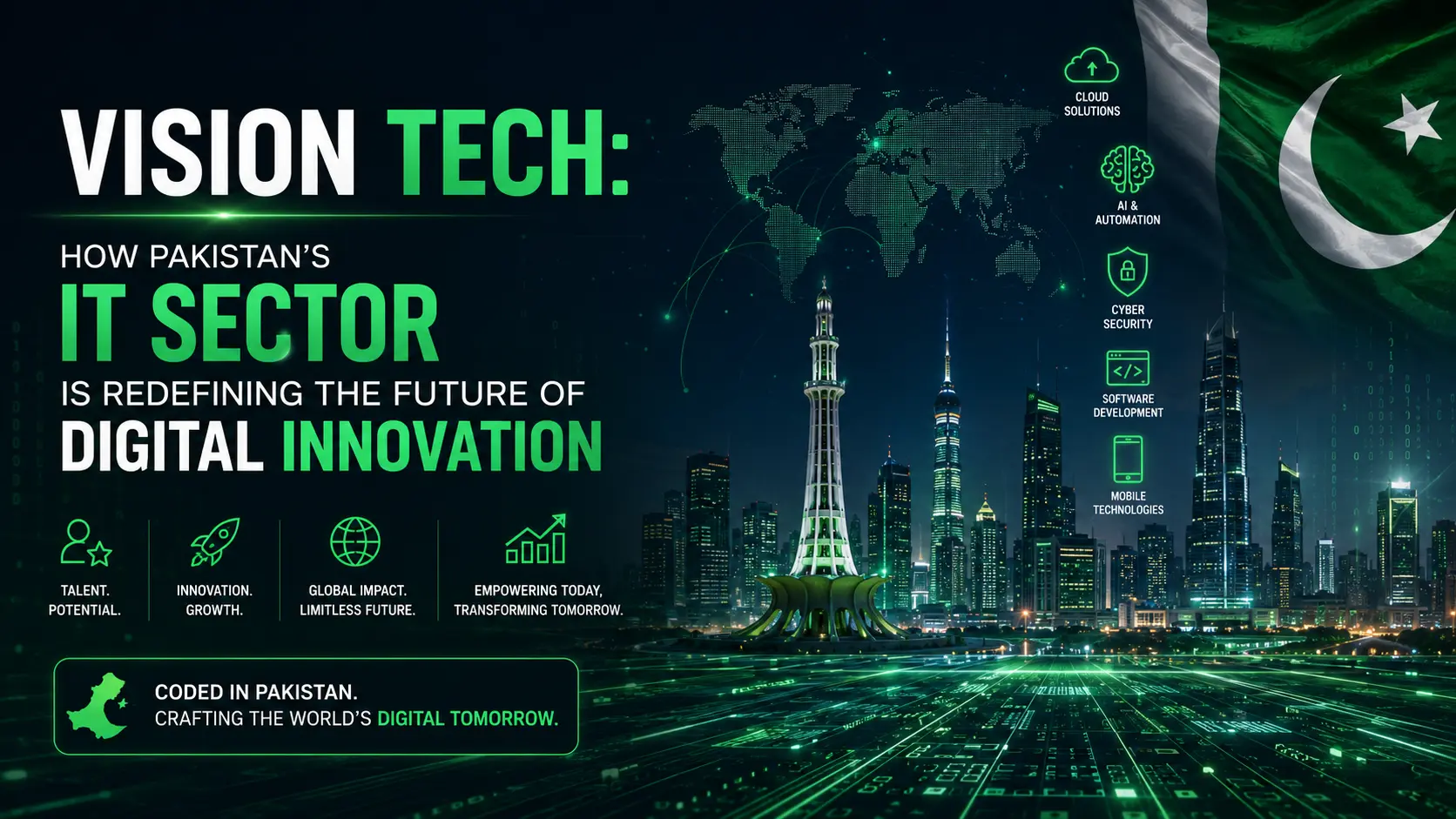
how Vision Tech is redefining Pakistan’s IT sector.? When people talk about which cities are quietly reshaping Pakistan’s digital economy, Karachi almost always comes up, and for good reason. The city is home to some of the most ambitious IT companies in South Asia, and sitting right at the heart of that transformation is a growing force known as vision tech.
Whether you are a startup founder searching for a reliable software partner, a business owner exploring digital solutions, or simply someone curious about where Pakistan’s technology story is headed, understanding what companies operating under the vision tech umbrella actually do gives you a real window into the country’s digital future.
This is not just a trend piece about buzzwords. This is a grounded look at what vision tech means on the ground, why Karachi has become a breeding ground for it, and what the future holds for businesses that are either building these solutions or seeking to benefit from them.
What Exactly Is Vision Tech And Why Does It Matter Right Now?
At its most literal level, vision tech refers to technology companies and IT solutions providers that are building with a long-range perspective. They are not just fixing today’s problems. They are engineering systems, software, and digital products that account for where industries are going — not just where they are.
In Pakistan’s context, this matters more than ever. The country’s IT export earnings crossed $3.2 billion in recent years, and the federal government’s AI policy is targeting the training of one million technology professionals while seeding 50,000 civic AI projects. The backdrop is clear: technology is no longer a support function for Pakistani businesses — it is the main event.
What separates a genuine vision tech company from a generic software house is the approach to problem-solving. Instead of treating every client as a project to be billed and closed, companies with a real tech vision invest in understanding an industry’s trajectory, build modular and scalable systems, and deliver work that serves clients three to five years from now — not just three to five months.
Why Is This City the Right Launchpad?
Vision tech Karachi companies have a unique advantage that firms in smaller cities simply do not have: direct access to enterprise clients. Karachi’s port economy, financial sector, textile industry, and retail ecosystem mean that software companies based here are solving real, high-stakes business problems — stock exchange backoffice software, fintech platforms, logistics tracking tools, and ERP systems for mid-sized manufacturers.
This is not theoretical work. Companies like Vision Technologies, operating out of Karachi’s Stock Exchange building since 1998, have deployed over 100 customized software solutions for brokerage houses and financial institutions. Another firm, Vision Tech, operating from Mashriq Center in Gulshan-e-Iqbal, has built its reputation across web development, mobile applications, digital marketing, custom AI models, and SEO — serving clients in the USA, UK, UAE, and Pakistan simultaneously.
What this tells us is that vision tech Karachi is not a single company — it is a category. It is a way of doing technology work that is rooted in Karachi’s commercial reality while reaching international markets.
The Services That Actually Matter
When you talk to any tech company worth working with, they will offer you a menu of services. But not all services are equal — and knowing what to look for tells you a lot about whether a company has genuine depth or is just checking boxes.
Software that scales.
This is the real test. Anyone can build something that works for a hundred users. Building something that still works smoothly at ten thousand users — without a complete rewrite — requires architectural thinking most firms do not invest in. Ask any prospective partner how they handle load and what their approach to database design looks like. The answer tells you everything.
Web development that is actually strategic.
A website is not a brochure anymore. It is a sales funnel, a customer service tool, and a brand statement simultaneously. The best vision tech companies treat web development as a business problem, not a design problem. They ask about your conversion goals before they talk about colors.
Mobile apps built for real users.
Pakistan’s mobile internet penetration has crossed 45% and keeps climbing. A mobile app that was designed as an afterthought, squeezed onto a smaller screen from a desktop design — feels exactly like what it is. The companies worth working with prototype on mobile first and scale up.
Custom AI tools, not off-the-shelf wrappers.
This is the area where the gap between good and great has grown dramatically in the past two years. Plenty of companies will sell you a ChatGPT integration. Very few can build you a domain-specific AI model trained on your industry’s data. The latter is where future tech vision lives — and it is what separates companies building for 2026 from those still catching up to 2023.
Digital marketing that connects to the product.
The best tech companies understand that building the product and getting it found are not separate disciplines. An SEO strategy developed alongside the website architecture, rather than bolted on after launch — performs meaningfully better. If a company pitches you development and marketing as completely separate departments with separate teams who never talk to each other, that is a flag.
The International Angle That Most People Underestimate
Here is something that rarely makes it into conversations about vision tech karachi: the international client base these companies are serving.
Multiple Karachi-based tech firms have built their entire model around nearshore delivery — meaning they function as embedded technology teams for companies in the United States, United Kingdom, and UAE. Not as outsourcing vendors. As actual partners who attend standups, review product roadmaps, and own outcomes alongside the client.
This matters for local businesses evaluating tech partners because it is a quality signal. A company that holds up under the expectations of enterprise clients in London or New York has already proven something that a purely local-facing firm has not. International clients, especially in regulated industries, demand documentation, testing protocols, security standards, and communication consistency that many domestic projects never require. The teams that have navigated those requirements come back sharper.
If you are a Pakistani business looking for a technology partner and a company tells you they serve international clients — ask them for specifics. Which markets? What kinds of projects? What did those clients expect from them? The answers reveal whether the international experience is genuine or a line on a slide deck.
Future Tech Vision: What Is Actually Coming
There is a difference between future tech vision as a real trend and as wishful thinking. Let me be concrete about what is genuinely underway in Pakistan’s technology sector.Artificial intelligence is no longer a side conversation. Pakistan’s federal government passed an AI policy
in 2025 that commits to training one million professionals and seeding tens of
thousands of AI-powered civic projects. The AI market here is growing at nearly 29% annually and is headed toward $3 billion by the end of the decade. Companies that are building AI competency right now — actual model training, fine-tuning, and deployment expertise — are making an investment that will pay out significantly over the next five years.
Cloud infrastructure is not optional anymore. The businesses that resisted cloud migration because of data sovereignty concerns or upfront costs are now watching competitors move faster, pay less for infrastructure, and recover from outages in minutes instead of days. Future tech vision companies have already made the architectural choices that make cloud deployment natural — they build for it from the first line of code.
Surveillance and UAV technology is a less-discussed but rapidly growing segment. Unmanned aerial systems are already in active use across Pakistan for agricultural monitoring, infrastructure inspection, and security applications. The companies building and deploying these systems are doing the kind of work that combines hardware, software, and real-time data processing in ways that would have seemed ambitious even five years ago.
Fintech and financial software is maturing. The stock exchange and banking sector in Pakistan have been early adopters of custom software, and the next phase is deeper automation, real-time risk analysis, and AI-assisted compliance monitoring. The firms that already have deep relationships in this space — and deep knowledge of how the financial infrastructure works are well-positioned.
Recognizing a Company With Genuine Tech Vision
After researching this space seriously, I have found that the distinguishing markers of a genuine vital tech vision company are simpler than most people think.
They ask questions before they make proposals. If a company sends you a quote within 48 hours of your first conversation — before they fully understand your business — that is not efficient. That is estimation. Real partners spend time understanding what you are trying to accomplish before they tell you what it will cost to accomplish it.
Their portfolio shows range. A company that has only built e-commerce sites cannot honestly claim to understand enterprise-grade software requirements. A company that has built for brokerage houses, healthcare providers, and international SaaS clients has demonstrated adaptability. Look at the breadth, not just the depth.
They talk about problems, not just features. The difference between “we build mobile apps” and “we help businesses reduce customer service calls by making information self-serve on mobile” is the difference between a vendor and a partner. The latter is thinking about your outcomes. The former is thinking about their deliverable.
They have stayed alive long enough to learn from mistakes. New companies can be exceptional — do not discount them. But a firm that has been operating for five or more years has made mistakes, learned from them, and refined its process. That institutional knowledge is worth something real.
A Genuine Note on Pakistan’s Tech Opportunity
I want to say something directly, without dressing it up.Pakistan is producing technically strong software engineers at a rate that is not matched by comparable economic opportunity within the country. The best of these engineers the ones who have worked on real-scale, real-pressure systems, are competing intellectually with peers in Berlin, Singapore, and Toronto. The economic gap creates a situation where international clients who partner with vision tech karachi companies get extraordinary capability at reasonable cost.
That gap will narrow over time. It always does as markets mature. The window for international businesses to build deep, long-term relationships with Pakistani tech partners at current rates is real — and it will not stay open indefinitely.
For Pakistani businesses, the opportunity is different but equally real. The talent is here. The infrastructure is here. And increasingly, the experience is here too. Choosing a technology partner who has genuine vision — who thinks past the next deliverable to the next five years of your business — is one of the highest-leverage decisions a growing company can make.
Wrapping Up
Vision tech is not a slogan. It is a standard.It is what separates software that solves today’s problem from systems that grow with your business. It is what separates a developer relationship that ends at go-live from a partnership that evolves as your market does. And in Karachi ,quietly, seriously, without much fanfare — some of the best practitioners of this standard are already doing the work.
Whether you are a local business trying to modernize, an international company looking for a reliable nearshore partner, or someone simply trying to understand where Pakistan’s tech sector is going the answer is somewhere in that intersection of technical depth, commercial seriousness, and long-range thinking that defines genuine future tech vision.The work is being done. The question is whether you are paying attention.


