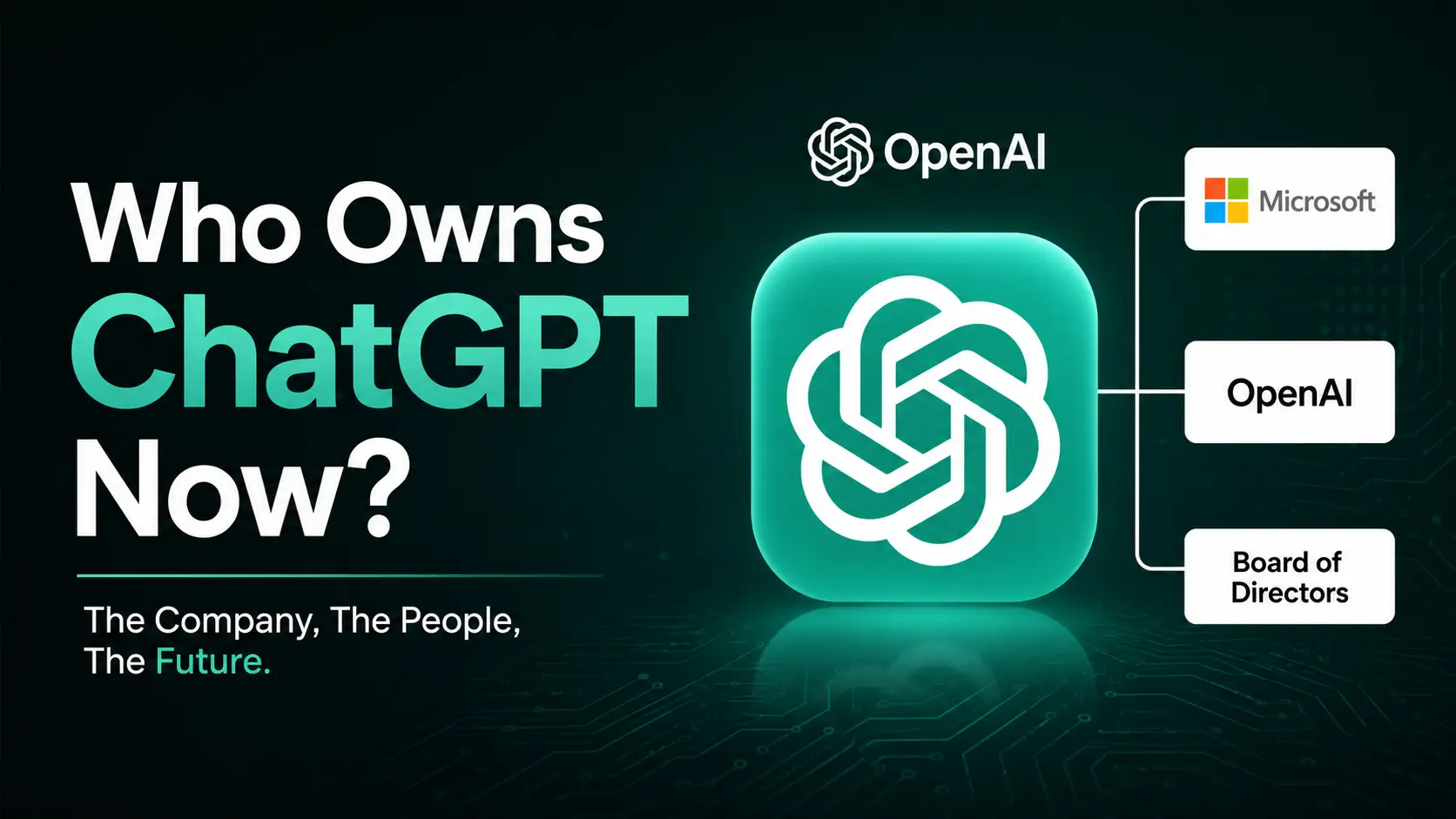
Who owns ChatGPT Now? Is it managed by a single corporation? The quick response is OpenAI. However, there is more to this answer than just one company.There is a public beneficiary corporation, a non-profit foundation, Microsoft, and many stakeholders. Together they have a share of one of the most cutting-edge technology companies of all time.
OpenAI Is the Legal Owner of ChatGPT
ChatGPT has been developed, built, and continues to be maintained by OpenAI. They have ownership of the model weights, research, the infrastructure, and brand of the chatbot which has around hundreds of millions users interacting with it weekly.
Regarding the ownership of ChatGPT, the simplest and most precise answer is OpenAI Group PBC. This is the name of the public benefit corporation that OpenAI restructured into from the nonprofit profit-capped LLC during their major restructuring in October 2025.
The new structure has retained the commitment to the nonprofit, but has allowed OpenAI greater latitude to compete and to raise the funds to compete.
No Single Person Owns the Company
No single founder, executive, or outside investor owns ChatGPT outright. That surprises a lot of people, especially given how closely Sam Altman’s name is tied to the product.
Altman is the CEO and the public face of the company. He holds a comparatively small personal equity stake.Ownership here is spread across a foundation, a major tech partner, and dozens of venture and institutional investors.
The Nonprofit Foundation Still Calls the Shots
This is the part that trips people up. OpenAI Foundation, the nonprofit entity that sits above the commercial business, holds roughly a quarter of the equity in OpenAI Group PBC.
It also retains special voting rights that give it ultimate governance control. In practice, that means the foundation’s board can override commercial decisions if it believes they conflict with OpenAI’s stated mission.
That mission centers on building artificial intelligence that benefits humanity broadly, not just shareholders.
Where This Governance Model Came From
This governance setup traces back to the chaotic weekend in November 2023. The nonprofit board briefly removed Altman as CEO before reinstating him days later after employee and investor pressure.
That episode exposed how much tension exists between OpenAI’s original nonprofit charter and the commercial pressure of running a product used by hundreds of millions of people.
The October 2025 restructuring was designed partly to resolve that tension. It gave the foundation clear legal authority while still allowing the business side to raise money and eventually consider a public listing.
Microsoft’s Role in Who Owns ChatGPT Now
Microsoft is the name most people associate with OpenAI’s finances, and for good reason. Microsoft has invested more than thirteen billion dollars into OpenAI over several funding rounds.
The company now holds one of the largest single equity stakes in OpenAI, reported at close to twenty seven percent following the 2025 restructuring. That investment funds a huge share of the computing power behind ChatGPT and other OpenAI products.
Training and running large language models requires enormous data center capacity, and Microsoft’s cloud is a core part of that supply chain.
What Microsoft Gets in Return
In exchange, Microsoft gets deep product integration. GPT models power parts of Copilot, Bing, Azure AI services, GitHub Copilot, and various Office tools.This partnership is exclusive in some technical respects, giving Microsoft early access to new models before wider release.
Still, Microsoft does not control OpenAI’s board, does not hold a majority stake, and cannot direct day to day decisions about ChatGPT. Anyone researching who owns ChatGPT Now quickly finds that Microsoft’s influence is financial and technical rather than a matter of outright ownership.
Other Investors Behind OpenAI
Microsoft gets most of the headlines, but OpenAI’s cap table includes a wide range of other backers. SoftBank has committed tens of billions of dollars across recent funding rounds.Nvidia, Amazon, and a cluster of venture firms including Thrive Capital, Khosla Ventures, Andreessen Horowitz, Sequoia Capital, Tiger Global, and Fidelity Investments all hold pieces of the company.A funding round in early 2026 alone raised over one hundred billion dollars. That pushed OpenAI’s valuation well past seven hundred billion dollars, with reports of an even higher valuation following a private round a few months later.
Why These Investors Matter
These investors bring capital, cloud infrastructure, and specialized hardware. Nvidia’s chips, for example, are central to training the models that power ChatGPT.Amazon’s cloud infrastructure adds a second major computing partner alongside Microsoft. None of these investors hold governance control comparable to the OpenAI Foundation.They own equity and expect financial returns, but the foundation’s board keeps the final say over mission related decisions.
What Happened to the Original Co-Founders
OpenAI was founded in December 2015 by a group that included Sam Altman, Elon Musk, Greg Brockman, Ilya Sutskever, and several others. Their stated goal was to build artificial general intelligence safely and openly.Musk provided significant early funding and public backing but left OpenAI’s board years before ChatGPT launched. He holds no ownership or governance role in the company today.
His public disputes with Altman, including lawsuits over the direction OpenAI took after moving away from its original open source ambitions, have played out publicly for years.Other early figures have also stepped back over time. Board members have come and gone as the company scaled from a small research lab into one of the most valuable private companies in the world.
Sam Altman remains the central figure steering the company. But the answer to who owns ChatGPT Now was never really about any one founder, since it has always been a shared structure involving the foundation and its commercial arm.
Why the Ownership Structure Matters to Everyday Users
Most people using ChatGPT don’t think twice about corporate structure, but it shapes real decisions that affect the product. The nonprofit foundation’s governance control means OpenAI can, in theory, prioritize safety commitments over short term revenue if the two conflict.
It also means major strategic moves, like partnerships, new funding rounds, or shifts in how models are released, pass through a layer of oversight that a typical venture backed startup doesn’t have.
Who Owns the Content You Create
There’s also the practical question of who owns what you create with the tool. OpenAI’s terms assign the rights to generated output to the user who created it, so you retain ownership of your own prompts and results.
That said, courts and copyright offices in several countries, including the United States, have generally required meaningful human authorship for something to be copyrightable. This creates its own separate legal debate around AI generated content.
Is OpenAI Planning to Go Public
Speculation about an initial public offering has grown throughout 2026. Reports suggest OpenAI has explored a listing that could arrive as early as late this year.
Internal discussions reportedly point toward pushing the timeline into 2027 to meet the stricter reporting and governance standards public companies face. A public listing would change the ownership picture again, opening shares to retail and institutional investors on the open market.
Given how much capital OpenAI continues to raise privately, a public offering isn’t guaranteed on any fixed timeline. The company has stated it expects to remain cash flow negative for several more years as it pours money into data centers and compute capacity.
How OpenAI’s Ownership Compares to Rivals
Looking at competitors puts OpenAI’s structure into better context. Google’s Gemini sits inside Alphabet, a single publicly traded parent that answers to shareholders through normal stock market mechanics, with no separate nonprofit layer sitting above it.
Meta’s AI models live inside Meta Platforms, again a conventional public company where Mark Zuckerberg holds outsized voting control through a dual class share structure.
Anthropic, the company behind Claude, runs as a public benefit corporation from the start, funded heavily by Amazon and Google. It doesn’t carry the nonprofit foundation layer that gives OpenAI’s board its unusual veto power over commercial decisions.
Why OpenAI’s Path Is Unusual
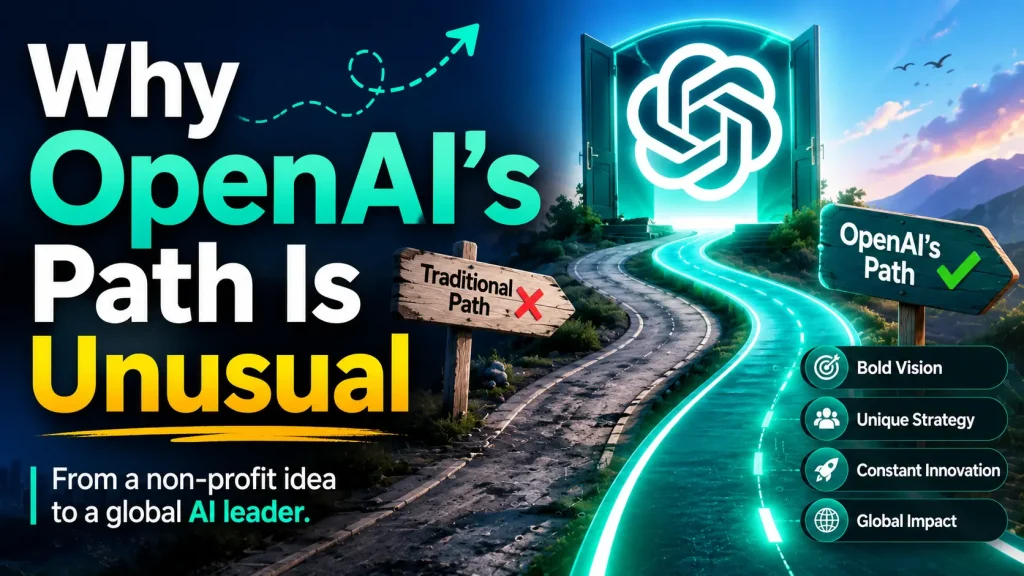
That comparison matters because it shows OpenAI chose a genuinely unusual path. Most large AI labs either sit inside an existing tech giant or operate as a straightforward startup answerable mainly to its investors and founders.
OpenAI instead built a structure where a mission focused nonprofit sits above a fast growing commercial business. That nonprofit keeps real legal teeth rather than existing as a symbolic gesture.
Supporters argue this protects against reckless decisions driven purely by growth pressure. Critics counter that the arrangement gives a small, unelected board enormous influence over a technology used by close to a billion people weekly.
Does This Affect Everyday Users
For everyday users comparing chatbots, this backstory rarely changes which tool feels most useful day to day. But for anyone tracking the business side of artificial intelligence, the ownership structure explains a lot.
A public company optimizes largely for shareholder value under securities law. OpenAI’s board can point to its charter and argue that safety and broad benefit come first, even if that occasionally slows down product releases.
The Bottom Line
So who owns ChatGPT in the simplest terms possible? OpenAI does, through OpenAI Group PBC, with the nonprofit OpenAI Foundation holding governance control and roughly a quarter of the equity.
Microsoft stands as the largest commercial shareholder and closest infrastructure partner, holding close to twenty seven percent, but it doesn’t run the company. A wide roster of investors including SoftBank, Nvidia, and Amazon fill out the rest of the cap table.
The structure looks complicated because it is complicated. It was built deliberately to balance a founding mission with the realities of competing in one of the most capital intensive industries in tech history.
Whatever happens with a future IPO or further restructuring, the core answer stays consistent. OpenAI built ChatGPT, OpenAI owns it, and a nonprofit board keeps final authority over where the company goes next.
FAQs
Who owns ChatGPT right now?
The OpenAI Group PBC. The OpenAI Foundation (non-profit) has governance control of the company. The largest commercial stakeholder with a ~27% share is Microsoft.
Who owns 51% of OpenAI?
There is no single owner of 51% of OpenAI. The OpenAI Foundation holds around 25% of the equity, and the rest is participated by the largest commercial stakeholder, Microsoft (around 27%). The rest of the shares are participated by SoftBank, Nvidia, and Amazon.
Does Elon Musk still own part of OpenAI?
No. After co-founding and funding OpenAI, Musk left the board of OpenAI years ago. He does not own part of OpenAI. He does retain a role in the legal disputes he has with OpenAI.
Is Sam Altman a billionaire?
Sam Altman’s net worth is estimated by Forbes at around 3.3 to 3.4 billion, and he has attained this by investing in firms such as Stripe and Reddit early on, and in Helion Energy. Altman has no equity in OpenAI, the company he leads, and this is why his net worth is not from OpenAI.