Do you know about BrandRank.ai Normalization Transformation Rules14 Tips?Your brand name might be spelled three different ways across the internet right now, and you probably don’t even know it. One directory has “Inc.” at the end. Your LinkedIn bio drops the space in your name. Your own press page still uses last year’s logo copy. To a human, none of that matters — everyone can tell it’s the same company. To an AI model trying to decide who to cite in an answer, it can look like three separate, weaker brands instead of one strong one.
That’s the exact problem sitting behind the phrase brandrank.ai normalization transformation rules. Before going further, one honest note: this is not a phrase pulled word-for-word from BrandRank.ai’s own product pages — it’s become shorthand across the AI-visibility space for the standardization work that platforms like BrandRank.ai measure and score. Once you understand what it actually covers, it’s one of the more practical things a brand can fix this quarter.
What “Normalization” Actually Means Here
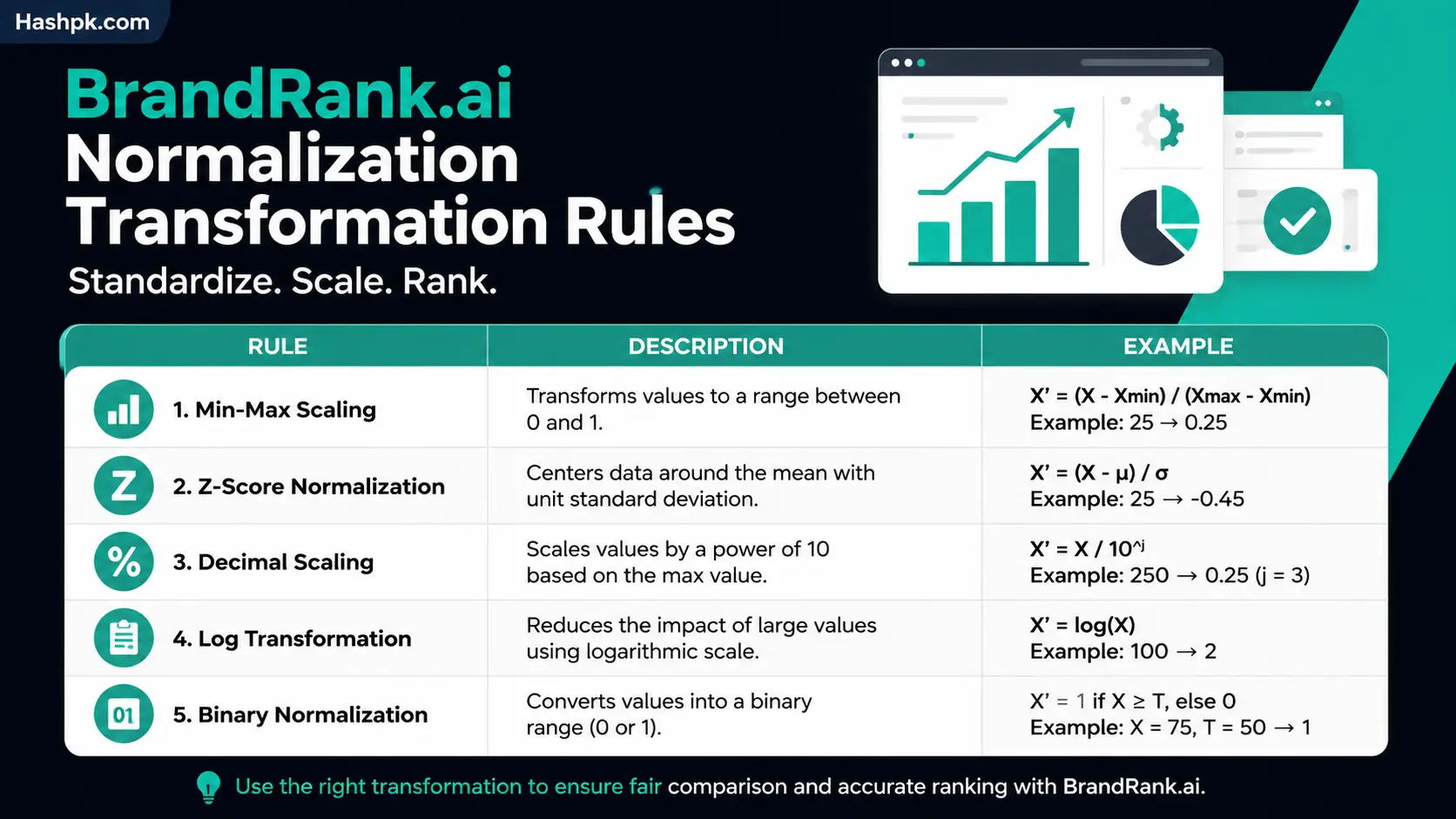
Normalization is the boring-sounding part that quietly decides whether an AI system recognizes your brand as one entity or several. It takes every messy version of your data,name spellings, addresses, product titles, category labels — and forces them into a single, agreed-upon shape.
Transformation is the next step. It reshapes that cleaned-up data into whatever format a downstream system needs — a schema block, a report, a data feed that an AI crawler can actually parse.Put together, normalization transformation rules are the plumbing that stops a brand’s identity from splintering across the web.
Why This Matters More in 2026 Than It Did in 2023
Search used to reward the page. Answer engines reward the entity. ChatGPT, Gemini, Perplexity, and Copilot don’t hand someone ten blue links anymore — they synthesize one answer and decide, in the background, who’s trustworthy enough to name.
That decision leans heavily on consistency. A brand that shows up the same way everywhere is easy for a model to trust. A brand that shows up five different ways looks, statistically, like five weaker signals instead of one strong one.
The Difference Between Being Findable and Being Cited
There’s a gap most brands don’t notice until it costs them a customer. Being findable means someone can locate your website if they go looking. Being cited means an AI system chooses to mention you, unprompted, while answering someone else’s question. The second one is worth far more, and it runs on a completely different set of signals than classic SEO ever did.
Generative Engine Optimization (GEO) and Answer Engine Optimization (AEO) both grew out of that gap. Where SEO asks “does this page deserve to rank,” GEO and AEO ask “does this brand deserve to be named.” Normalization transformation rules are the unglamorous infrastructure underneath both answers — the reason a model trusts you enough to say your name out loud.
Normalization vs. Transformation vs. Traditional SEO
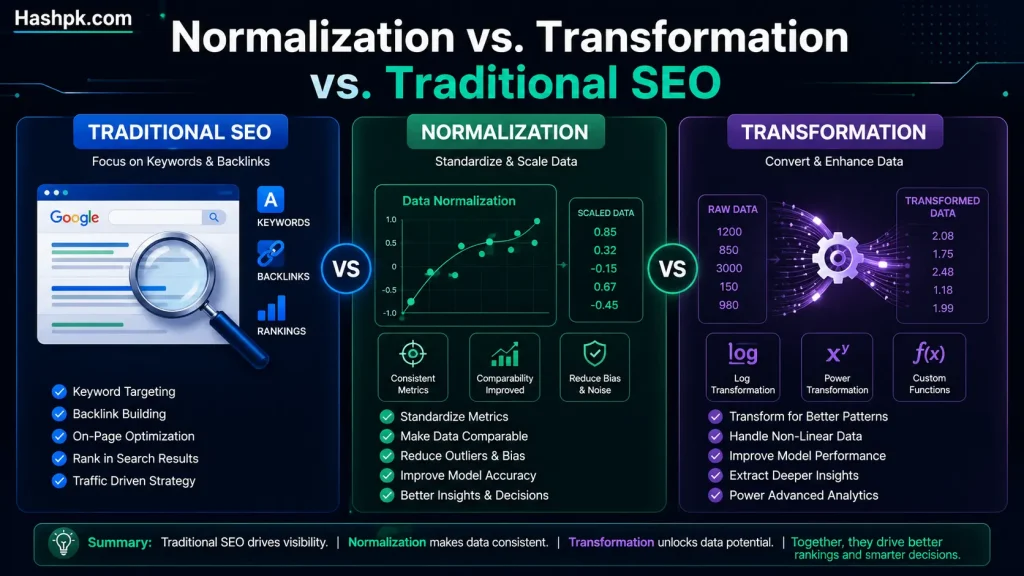
A lot of the confusion in this space comes from people treating these as the same discipline. They aren’t.
| Factor | Traditional SEO | Normalization Transformation Rules |
| Main goal | Rank a page on a results page | Get recognized and cited as one clear entity |
| What it fixes | Keywords, backlinks, page speed | Name variants, address formats, category labels |
| Where it lives | On-page content, technical crawlability | Schema markup, directory listings, structured data |
| Who “grades” it | Search engine algorithms | AI answer engines synthesizing a response |
| Failure symptom | Low rankings, thin traffic | Inconsistent or missing brand mentions in AI answers |
| Fix timeline | Weeks to months | Ongoing — new inconsistencies appear constantly |
Both matter. Neither replaces the other.
14 Practical Tips
Most guides on this topic stop at defining the concept. These are the actionable moves worth doing first.
1. Pick One Canonical Brand Name and Write It Down
Not “roughly consistent” — one exact string, exact casing, exact punctuation. Put it in a shared document every writer and agency can reference.
2. Build an Exceptions List Before You Automate Anything
Automated casing rules will happily break “eBay” into “Ebay” if nobody tells them not to. List every brand or product name that intentionally breaks standard formatting, and protect it.
3. Audit Your Top 10 Touchpoints First, Not All 200
Start with the places AI systems and humans both check constantly: your homepage, Google Business Profile, LinkedIn, Crunchbase, Wikipedia (if applicable), and your two or three biggest directory listings.
4. Never Overwrite Raw Data — Archive It
Keep the original, messy version alongside the cleaned one. If a normalization rule turns out to be wrong, you need something to roll back to.
5. Sequence Your Rules Deliberately
Order changes outcomes. Strip legal suffixes before checking capitalization. Check the exceptions list before applying default casing. Resolve the entity before touching location data. Get the order wrong and you can quietly corrupt data that looked fine.
6. Treat Sources With Different Trust Levels Differently
A verified enrichment feed and a random public form submission should not carry equal weight. Build simple source-priority logic so good data doesn’t get overwritten by weak data.
7. Put Real @sameAs Links in Your Organization Schema
This property tells crawlers directly that your website, LinkedIn page, and other profiles all describe the same entity. It’s a small technical addition with a disproportionate payoff for entity resolution.
8. Standardize Category Language to Match How AI Already Describes You
Ask ChatGPT, Gemini, and Perplexity what category they’d put your brand in. Then align your own site copy and metadata to that same wording instead of internal jargon nobody outside your company uses.
9. Fix Address Formatting Everywhere at Once
Multi-location brands especially: pick one format (street, city, two-letter state, ZIP) and apply it identically across every directory, map listing, and footer.
10. Don’t Let Old Brand Names Linger After a Rebrand
Redirect old domains, update old press releases where you can, and reach out to the highest-authority sites still using the previous name. Historical content volume can otherwise keep outranking your current identity.
11. Normalize Continuously, Not Once a Year
New listings, new reviews, and new pages get created constantly. A one-time cleanup decays within months. Build normalization into ongoing content and data workflows instead of treating it as a project with an end date.
12. Validate Before Anything Goes Live
Add a check step that catches malformed entries, accidental duplicate merges, and fields that don’t match the expected format — before the “cleaned” data ships anywhere.
13. Give AI Models Something Specific to Cite
Vague marketing language is hard to quote. Specific numbers, named methodologies, and verifiable claims are easy for a model to lift and attribute. Rewrite thin claims into concrete, checkable statements.
14. Monitor, Don’t Assume
Set a recurring check — monthly or quarterly — where someone actually tests how your brand shows up across two or three AI answer engines. Treat drift as expected, not exceptional.
Assign a Human Owner
Every one of the thirteen tips above tends to fail quietly if nobody owns it. SEO teams focus on rankings. PR teams focus on coverage volume. Nobody defaults to owning “does an AI model describe us correctly.” Naming one person or team responsible for normalization — even part-time — is often what separates brands that actually fix this from brands that read about it and move on.
Who Should Actually Be Doing This Work
This isn’t strictly a job for data engineers, and it isn’t strictly a marketing task either. In practice, it sits between three teams: content and SEO (who control on-site copy and metadata), technical or web teams (who implement schema markup and redirects), and brand or PR teams (who manage how the company is described externally and who can push for corrections on third-party platforms).
Smaller companies can often run this as one person spending a few focused hours a month. Larger, multi-brand organizations usually need a lightweight governance process — a shared document, a review cadence, and a clear escalation path when a directory listing or old press release needs correcting.
Where Normalization Efforts Usually Fail
| Common Failure | What It Looks Like | Practical Fix |
| Rebrand left unfinished | Old and new brand names both live in search and AI training data | Redirects, outreach to top referring sites, updated schema |
| Product name drift | Marketing, sales, and support each use a different product label | One naming style guide, enforced across every team and agency |
| Duplicate directory listings | Two or three versions of the same business profile on one platform | Claim, merge, and standardize NAP (name, address, phone) data |
| Overly generic content | Pages full of “industry-leading” language with no specifics | Replace vague claims with concrete, sourced statistics |
| No clear owner internally | SEO, PR, and brand teams each assume someone else handles this | Assign explicit ownership of AI-visibility and normalization work |
How to Tell If It’s Actually Working
Skip the vanity metrics. Watch for three things instead: whether AI answer engines start naming your brand consistently for relevant prompts, whether your name/address/category data finally matches across your top touchpoints, and whether new inconsistencies show up less often each time you check.
None of this happens overnight. Schema and on-site fixes can influence how crawlers read you within weeks. Third-party directories and historical content take longer, since they run on their own update cycles.
Final Thought
Nobody wakes up excited to fix address formatting or hunt down an old rebrand that never got fully cleaned up. But that unglamorous work is quickly becoming the difference between a brand AI systems recognize confidently and one they quietly skip over.
None of this requires a huge budget or a specialized team to start. It requires someone deciding to actually look — auditing the top ten places your brand shows up, writing down the one correct version of every name, address, and category label, and then defending that consistency every time new content goes live. Do that first, keep checking it quarterly, and the rest of this list becomes a lot easier to work through.
Frequently Asked Questions
Is “brandrank.ai normalization transformation rules” an official product name?
Not exactly. It’s a phrase that’s become common shorthand in the AI-visibility space for the standardization work platforms like BrandRank.ai track and score, rather than a documented feature name on the company’s own site.
Does this replace SEO?
No. It sits alongside it. Traditional SEO still decides search rankings; normalization decides whether AI answer engines recognize and trust your brand as one consistent entity.
How long does full normalization take?
There’s no fixed timeline. Owned-channel fixes can happen in weeks. Third-party listings and historical content residue can take a couple of quarters to fully settle.
Do small brands need this, or only enterprises?
Smaller brands often have an advantage here — fewer legacy pages, fewer historical name variants, and a smaller footprint to clean up quickly.
What’s the single highest-impact fix to start with?
Auditing your top ten touchpoints for name, address, and category consistency. It’s the fastest way to find where the biggest gaps are hiding.
Can a tool fully automate normalization, or does it still need a human?
Tools can flag inconsistencies and apply bulk fixes fast, but decisions like exception lists, category wording, and outreach for third-party corrections still need human judgment. Automation speeds up the mechanical part; it doesn’t replace the strategy.