
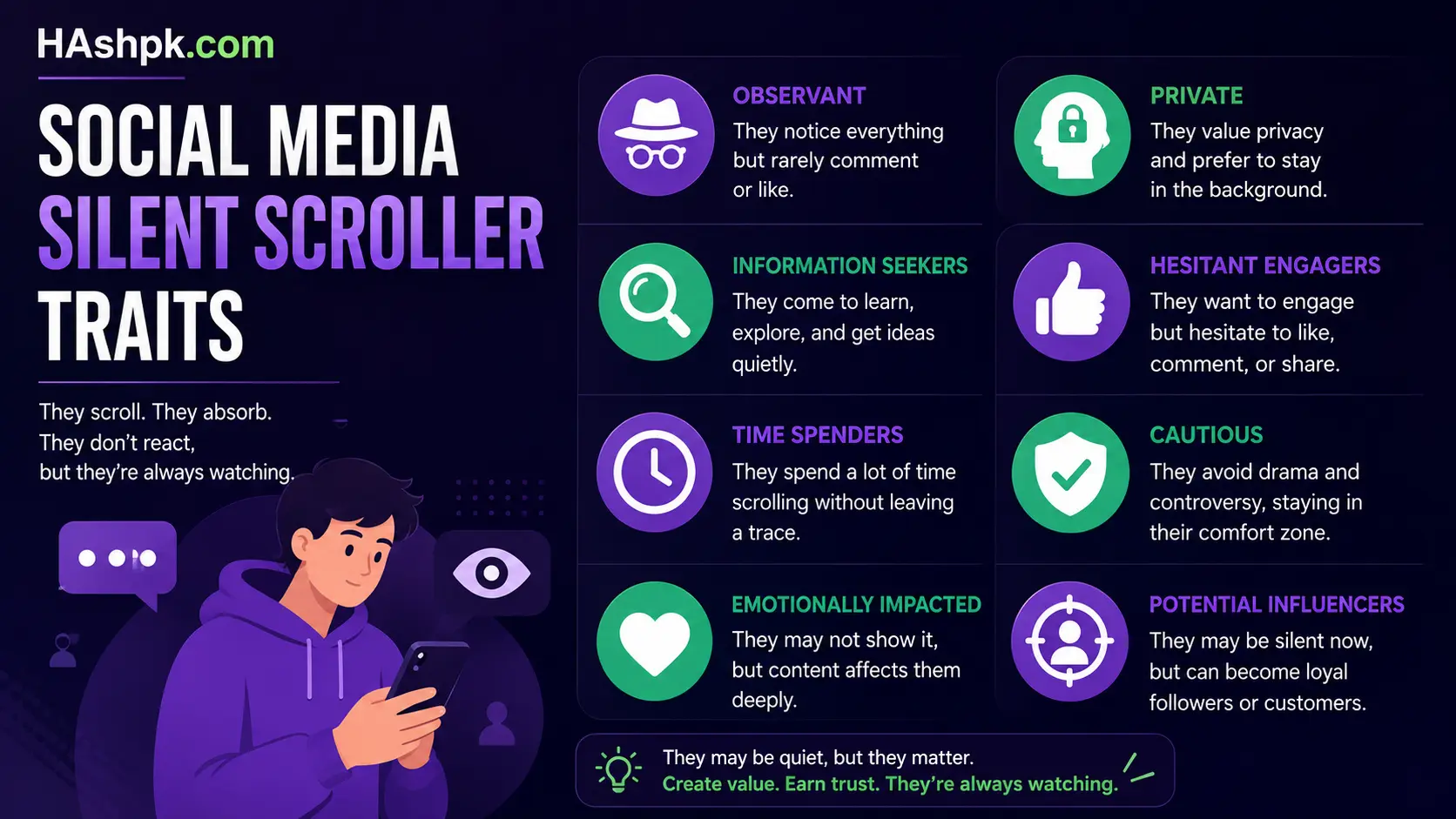
Open any social app and you will find a crowd that never says a word. They watch. They save. They screenshot. Then they leave without a trace. The Nielsen Norman Group gave this pattern a na open any social app and you will find a crowd that never says a word. They watch. They save. They screenshot. Then they leave without a trace.
The Nielsen Norman Group gave this pattern a name: participation inequality. In most online communities, roughly 90% of people observe without contributing, 9% contribute occasionally, and 1% create almost everything the rest of us see. Social feeds behave the same way.
Learning to read social media silent scroller traits is one of the most useful skills a marketer can build right now. These quiet users are not dead weight on your follower count. They are the majority of your audience, and often the majority of your buyers.DataReportal’s Digital 2026 report puts average daily social media use at around 2 hours and 21 minutes per person. Almost none of that time is spent typing a comment.
What Are Social Media Silent Scrollers?
A silent scroller is someone who consumes content regularly but almost never reacts in public. No likes. No comments. No shares you can see in your reports.
They are usually called lurkers on social media, though that word makes them sound suspicious. They are not. Most are simply people using the app the way it feels natural to use it.
It helps to separate three groups that look identical inside a dashboard:
- Silent watchers – they see nearly everything you post and remember it.
- Selective silent users – they react once every few months, usually to something personal.
- Ghost accounts – abandoned profiles that only inflate your follower number.
Only the third group is worthless to you. The first two are your warmest audience. You just cannot see them clearly.
Why Do People Scroll Without Engaging?
Most people never open an app planning to publish anything. DataReportal reports that the leading reasons for social media use are keeping in touch with friends and family (about 49%), filling spare time (about 39%), and reading news (about 30%). Posting sits far lower on that list.
Beyond intent, four everyday forces shape this scrolling behavior:
- Social cost. A like is public. It lands in a friend’s feed, a colleague’s notifications, a stranger’s screen.
- People scroll while cooking, commuting, or standing in line. Typing takes effort a thumb-flick does not.
- Feed control. Experienced users know reacting trains the algorithm, so they stay quiet to protect their feed.
- Nothing to add. Plenty of people enjoy content and simply feel they have no comment worth making.
Best 29 Social Media Silent Scroller
| # | Trait | Description |
|---|---|---|
| 1 | Scrolls for hours | Feed pe bohot waqt guzarta hai lekin kabhi interact nahi karta |
| 2 | Never likes posts | Content pasand aane ke bawajood like button press nahi karta |
| 3 | Avoids commenting | Apni opinion share karne se bachta hai, sirf padhta hai |
| 4 | Watches stories quietly | Stories dekhta hai lekin reply ya reaction nahi bhejta |
| 5 | Fear of judgment | Log kya sochenge, is soch se interact karne se katata hai |
| 6 | High information intake | News, trends, memes sab kuch absorb karta hai |
| 7 | Low content output | Khud kabhi post ya story nahi banata |
| 8 | Screenshots instead of sharing | Post share karne ke bajaye screenshot le kar save kar leta hai |
| 9 | Follows many, engages few | Bohot accounts follow karta hai lekin sirf 1-2% se interact karta hai |
| 10 | Prefers observing over participating | Discussion mein shamil hone se zyada dekhna pasand karta hai |
| 11 | Checks notifications rarely reacts | Notifications dekhta hai but reply nahi karta |
| 12 | Values privacy | Apni activity ko public se hide rakhna chahta hai |
| 13 | Curates a mental list | Interesting content ko dimaag mein yaad rakhta hai, save nahi karta |
| 14 | Avoids DMs | Direct messages start karne se hesitate karta hai |
| 15 | High awareness, low visibility | Trends se updated rehta hai lekin khud invisible rehna pasand karta hai |
| 16 | Rarely updates profile | Bio, profile picture zyada change nahi karta |
| 17 | Consumes controversial content silently | Debates padhta hai lekin side nahi leta |
| 18 | Uses multiple platforms passively | Instagram, X, TikTok sab pe active hai lekin sab pe silent |
| 19 | Enjoys anonymity | Bina attention liye content enjoy karna pasand karta hai |
| 20 | Low emoji/reaction usage | Reactions bhi kam use karta hai, jaise sirf “seen” karta hai |
| 21 | Highly selective engagement | Kabhi kabhi sirf close friends ke posts pe react karta hai |
| 22 | Avoids public opinions | Political ya sensitive topics pe kabhi post nahi karta |
| 23 | Introverted online behavior | Real life introvert trait online bhi reflect hota hai |
| 24 | Prefers lurking in groups | Facebook/WhatsApp groups mein sirf messages padhta hai |
| 25 | Analytical mindset | Content ko judge/analyze karta hai bina react kiye |
| 26 | FOMO without participation | Trends miss nahi karna chahta lekin part nahi leta |
| 27 | Time-heavy, action-light usage | App pe time zyada, actual clicks/taps kam |
| 28 | Rarely tags friends | Kisi post pe friends ko tag karna avoid karta hai |
| 29 | Content consumer, not creator identity | Khud ko “audience” samajhta hai, “creator” nahi |
Top Social Media Silent Scroller Traits
Quiet audiences are not random. Watch closely and the same patterns show up across industries and platforms.
1. High attention, low reaction
Silent scrollers often have sharper brand recall than commenters. They notice when your tone changes, when your pricing page updates, when you go quiet for a week. Their attention is real. Only the feedback loop is missing.
Picture a small bakery that posts every morning for a year. The comment count stays low. Then a customer walks in and orders the seasonal cake by name before it has ever been listed on the menu board. Nothing in the analytics predicted that visit.
2. They save instead of commenting
A save is a private vote of confidence. It costs nothing socially and carries clear intent. Finance creators, recipe pages, and B2B accounts usually see saves climb long before comments do.
Compare two posts with identical likes. If one collects five times the saves, that is the post your audience plans to act on. Saves measured against reach are one of the clearest signals of digital consumer behavior available to a small brand.
3. They share privately, not publicly
This is the biggest blind spot in reporting. Statista’s analysis of sharing channels found that roughly 69% of global content shares happen through private channels such as messaging apps, email, and DMs rather than public share buttons. Your best post may be moving through five group chats while your dashboard shows two shares.
4. They avoid comment sections on purpose
For many users the worry is not the post. It is the reply. One clumsy sentence can invite pile-ons, screenshots, or an argument with a stranger. Silent users weigh that risk and step back, especially on money, health, and politics.
5. They protect their professional image
This trait peaks on LinkedIn. Liking a job ad, a competitor’s post, or a strong opinion is visible to managers, clients, and recruiters. Many professionals read an entire carousel, learn from it, and close the app without touching a button. Recruiters see this constantly: a role gets three likes and forty private applications.
6. They buy quietly and late
A silent scroller may follow you for eight months, never react once, then open a DM with “I’ve been watching your work for a while.” That is not a cold lead. That is a warm lead you never got to count.
7. They curate their feed deliberately
More users now treat a like as an input rather than an opinion. They avoid engaging with content they do not want more of, including content they genuinely enjoy. Silence here is a filtering choice, not a rejection.
The Psychology Behind Silent Scrolling
Social media psychology explains most of this behaviour, and it usually comes down to perceived risk against perceived reward.
Evaluation apprehension. People overestimate how closely others watch what they post. Commenting feels like standing up in a room. Scrolling feels like sitting in the back row.
Identity signalling. Every public interaction is a small statement about who you are. Liking a brand post ties you to that brand in front of everyone you know.
Low-arousal browsing. A lot of scrolling happens half-tired, late at night, in bed. In that state the brain is receiving, not producing. Interaction needs a gear change most people never make.
The bystander effect. When a post already has 400 comments, individuals feel less need to speak. Someone else has said it.
How Silent Scrollers Impact Brands and Creators
The impact cuts both ways.
Your metrics understate your reach. Benchmark studies from firms such as Rival IQ and Socialinsider place median engagement rates for brand accounts on Instagram and Facebook well under 1%. That figure describes a habit, not the quality of your work.
Attribution breaks. When private sharing drives visits, analytics files them as direct traffic, so marketers underfund the content that is actually working.
Creators burn out. Chasing comments pushes people toward louder, more argumentative posts, because conflict is one of the few things that reliably drags quiet users into the open. It works, and it usually costs trust.
There is an upside. A large silent audience is a stable one. These users do not unfollow in waves, do not demand attention, and buy when they are ready.
How to Turn Silent Scrollers into Active Followers
You will never convert all of them, and you should not try. But you can lower the barrier to a first interaction.
Reduce the cost of the first click
Give people ways to respond that reveal nothing about them:
- Two-option polls instead of open questions
- “Tap if this sounds familiar” stickers
- Emoji sliders and quiz stickers
- One-word reply prompts
Make content worth saving
Saves are the silent scroller’s native language. Build for them with checklists, step-by-step frameworks, comparison posts, templates, and swipe files. Anything a person may need again next month earns a save today.
Move the call to action into private space
Ask for DMs instead of comments. A DM feels like a conversation; a comment feels like a performance. “Message me the word GUIDE” almost always beats “comment below” with a quiet audience.
Build trust before you ask for anything
Silent users watch for consistency. Show your process, your results, and your mistakes. Answer awkward questions in public. Trust is what turns a nine-month watcher into a customer.
Measure what quiet people actually do
Track saves, watch-through rate, profile visits, DM volume, branded search, and direct traffic. Then add a simple “How did you hear about us?” field to your enquiry or checkout form. That one line recovers a surprising amount of hidden attribution.
Common Myths About Silent Scrollers
- Silence means disinterest. Often it means the opposite. They read everything and never felt the need to say so.
- They are all bots or dead accounts. Some are. Most are ordinary users behaving normally.
- More calls to action will fix it. Repeated asking usually lowers trust rather than raising interaction.
- Silent followers never buy. Private sharing and delayed purchases suggest otherwise.
- Engagement rate measures content quality. It measures how willing people feel to be seen reacting.
The Future of Silent Scrolling in Social Media
Three shifts are turning silence into the default rather than the exception.
Feeds are recommendation-led. Platforms increasingly serve content based on watch behaviour rather than who you follow, so a public like matters less to distribution than it once did.
Sharing keeps moving into private space. Group chats and DMs are where real recommendations happen now, and encryption means marketers see less of that traffic every year.
Content is going zero-click. People read the carousel, take the point, and never leave the app. The value transfer happens with no measurable action attached.
The practical response is not to fight this. It is to change what you count and design content that works even when nobody claps.
Conclusion
The quiet part of your audience is doing more work than your dashboard suggests. Once you can read social media silent scroller traits – high attention, private saving, hidden sharing, delayed buying – a low comment count stops looking like failure and starts looking like normal human behaviour.
Stop optimising for applause. Optimise for usefulness, consistency, and content people want to keep. Audit your last thirty posts against saves and DMs instead of likes, and your quiet audience has probably already told you what they want more of.
FAQs
Who are the silent scrollers on social media?
Consuming videos, reading captions, and saving posts are all done without visible contributions that show up in social media analytics. These users are known as silent scrollers. They may be the largest segment of the audience for a brand, and because they consume so much content, they may have greater brand recall than the users who actively comment and participate the most.
What are some reasons that people do not engage with social media content even when they like the content?
There is a cost associated with social media engagement that is not present when content is consumed. For the majority, a like or comment is visible to a user’s friends and social media connections, so many users are private consumers to protect their social image. Some users have no purposeful comments to contribute, and in some cases, users engage silently to prevent social media algorithms from creating a feed of similar posts.
How do silent scrollers impact social media engagement and reach?
They do impact measurable engagement, but they are not a negative audience for your brand or business. Silent users are still making contributions like saving, sharing, and visiting profiles. The majority of social media platforms incentivize these actions as engagement. Silent scrollers tend to be a stable audience and loyal followers. Businesses take a real risk by misinterpreting data and abandoning a content strategy that is working because of the absence public engagement and comments.
. In most online communities, roughly 90% of people observe without contributing, 9% contribute occasionally, and 1% create almost everything the rest of us see. Social feeds behave the same way.
Learning to read social media silent scroller traits is one of the most useful skills a marketer can build right now. These quiet users are not dead weight on your follower count. They are the majority of your audience, and often the majority of your buyers.
DataReportal’s Digital 2026 report puts average daily social media use at around 2 hours and 21 minutes per person. Almost none of that time is spent typing a comment.
What Are Social Media Silent Scrollers?
A silent scroller is someone who consumes content regularly but almost never reacts in public. No likes. No comments. No shares you can see in your reports.
They are usually called lurkers on social media, though that word makes them sound suspicious. They are not. Most are simply people using the app the way it feels natural to use it.
It helps to separate three groups that look identical inside a dashboard:
- Silent watchers – they see nearly everything you post and remember it.
- Selective silent users – they react once every few months, usually to something personal.
- Ghost accounts – abandoned profiles that only inflate your follower number.
Only the third group is worthless to you. The first two are your warmest audience. You just cannot see them clearly.
Why Do People Scroll Without Engaging?
Most people never open an app planning to publish anything. DataReportal reports that the leading reasons for social media use are keeping in touch with friends and family (about 49%), filling spare time (about 39%), and reading news (about 30%). Posting sits far lower on that list.
Beyond intent, four everyday forces shape this scrolling behavior:
- Social cost. A like is public. It lands in a friend’s feed, a colleague’s notifications, a stranger’s screen.
- People scroll while cooking, commuting, or standing in line. Typing takes effort a thumb-flick does not.
- Feed control. Experienced users know reacting trains the algorithm, so they stay quiet to protect their feed.
- Nothing to add. Plenty of people enjoy content and simply feel they have no comment worth making.
None of these reasons signal a weak audience. They describe ordinary content consumption habits shaped by convenience and self-protection, and no caption tweak will remove them.
Top Social Media Silent Scroller Traits
Quiet audiences are not random. Watch closely and the same patterns show up across industries and platforms.
1. High attention, low reaction
Silent scrollers often have sharper brand recall than commenters. They notice when your tone changes, when your pricing page updates, when you go quiet for a week. Their attention is real. Only the feedback loop is missing.
Picture a small bakery that posts every morning for a year. The comment count stays low. Then a customer walks in and orders the seasonal cake by name before it has ever been listed on the menu board. Nothing in the analytics predicted that visit.
2. They save instead of commenting
A save is a private vote of confidence. It costs nothing socially and carries clear intent. Finance creators, recipe pages, and B2B accounts usually see saves climb long before comments do.
Compare two posts with identical likes. If one collects five times the saves, that is the post your audience plans to act on. Saves measured against reach are one of the clearest signals of digital consumer behavior available to a small brand.
3. They share privately, not publicly
This is the biggest blind spot in reporting. Statista’s analysis of sharing channels found that roughly 69% of global content shares happen through private channels such as messaging apps, email, and DMs rather than public share buttons. Your best post may be moving through five group chats while your dashboard shows two shares.
4. They avoid comment sections on purpose
For many users the worry is not the post. It is the reply. One clumsy sentence can invite pile-ons, screenshots, or an argument with a stranger. Silent users weigh that risk and step back, especially on money, health, and politics.
5. They protect their professional image
This trait peaks on LinkedIn. Liking a job ad, a competitor’s post, or a strong opinion is visible to managers, clients, and recruiters. Many professionals read an entire carousel, learn from it, and close the app without touching a button. Recruiters see this constantly: a role gets three likes and forty private applications.
6. They buy quietly and late
A silent scroller may follow you for eight months, never react once, then open a DM with “I’ve been watching your work for a while.” That is not a cold lead. That is a warm lead you never got to count.
7. They curate their feed deliberately
More users now treat a like as an input rather than an opinion. They avoid engaging with content they do not want more of, including content they genuinely enjoy. Silence here is a filtering choice, not a rejection.
The Psychology Behind Silent Scrolling
Social media psychology explains most of this behaviour, and it usually comes down to perceived risk against perceived reward.
Evaluation apprehension. People overestimate how closely others watch what they post. Commenting feels like standing up in a room. Scrolling feels like sitting in the back row.
Identity signalling. Every public interaction is a small statement about who you are. Liking a brand post ties you to that brand in front of everyone you know.
Low-arousal browsing. A lot of scrolling happens half-tired, late at night, in bed. In that state the brain is receiving, not producing. Interaction needs a gear change most people never make.
The bystander effect. When a post already has 400 comments, individuals feel less need to speak. Someone else has said it.
How Silent Scrollers Impact Brands and Creators
The impact cuts both ways.
Your metrics understate your reach. Benchmark studies from firms such as Rival IQ and Socialinsider place median engagement rates for brand accounts on Instagram and Facebook well under 1%. That figure describes a habit, not the quality of your work.
Attribution breaks. When private sharing drives visits, analytics files them as direct traffic, so marketers underfund the content that is actually working.
Creators burn out. Chasing comments pushes people toward louder, more argumentative posts, because conflict is one of the few things that reliably drags quiet users into the open. It works, and it usually costs trust.
There is an upside. A large silent audience is a stable one. These users do not unfollow in waves, do not demand attention, and buy when they are ready.
How to Turn Silent Scrollers into Active Followers
You will never convert all of them, and you should not try. But you can lower the barrier to a first interaction.
Reduce the cost of the first click
Give people ways to respond that reveal nothing about them:
- Two-option polls instead of open questions
- “Tap if this sounds familiar” stickers
- Emoji sliders and quiz stickers
- One-word reply prompts
Make content worth saving
Saves are the silent scroller’s native language. Build for them with checklists, step-by-step frameworks, comparison posts, templates, and swipe files. Anything a person may need again next month earns a save today.
Move the call to action into private space
Ask for DMs instead of comments. A DM feels like a conversation; a comment feels like a performance. “Message me the word GUIDE” almost always beats “comment below” with a quiet audience.
Build trust before you ask for anything
Silent users watch for consistency. Show your process, your results, and your mistakes. Answer awkward questions in public. Trust is what turns a nine-month watcher into a customer.
Measure what quiet people actually do
Track saves, watch-through rate, profile visits, DM volume, branded search, and direct traffic. Then add a simple “How did you hear about us?” field to your enquiry or checkout form. That one line recovers a surprising amount of hidden attribution.
Common Myths About Silent Scrollers
- Silence means disinterest. Often it means the opposite. They read everything and never felt the need to say so.
- They are all bots or dead accounts. Some are. Most are ordinary users behaving normally.
- More calls to action will fix it. Repeated asking usually lowers trust rather than raising interaction.
- Silent followers never buy. Private sharing and delayed purchases suggest otherwise.
- Engagement rate measures content quality. It measures how willing people feel to be seen reacting.
The Future of Silent Scrolling in Social Media
Three shifts are turning silence into the default rather than the exception.
Feeds are recommendation-led. Platforms increasingly serve content based on watch behaviour rather than who you follow, so a public like matters less to distribution than it once did.
Sharing keeps moving into private space. Group chats and DMs are where real recommendations happen now, and encryption means marketers see less of that traffic every year.
Content is going zero-click. People read the carousel, take the point, and never leave the app. The value transfer happens with no measurable action attached.
The practical response is not to fight this. It is to change what you count and design content that works even when nobody claps.
Conclusion
The quiet part of your audience is doing more work than your dashboard suggests. Once you can read social media silent scroller traits – high attention, private saving, hidden sharing, delayed buying – a low comment count stops looking like failure and starts looking like normal human behaviour.
Stop optimising for applause. Optimise for usefulness, consistency, and content people want to keep. Audit your last thirty posts against saves and DMs instead of likes, and your quiet audience has probably already told you what they want more of.
FAQs
Who are the silent scrollers on social media?
Consuming videos, reading captions, and saving posts are all done without visible contributions that show up in social media analytics. These users are known as silent scrollers. They may be the largest segment of the audience for a brand, and because they consume so much content, they may have greater brand recall than the users who actively comment and participate the most.
What are some reasons that people do not engage with social media content even when they like the content?
There is a cost associated with social media engagement that is not present when content is consumed. For the majority, a like or comment is visible to a user’s friends and social media connections, so many users are private consumers to protect their social image. Some users have no purposeful comments to contribute, and in some cases, users engage silently to prevent social media algorithms from creating a feed of similar posts.
How do silent scrollers impact social media engagement and reach?
They do impact measurable engagement, but they are not a negative audience for your brand or business. Silent users are still making contributions like saving, sharing, and visiting profiles. The majority of social media platforms incentivize these actions as engagement. Silent scrollers tend to be a stable audience and loyal followers. Businesses take a real risk by misinterpreting data and abandoning a content strategy that is working because of the absence public engagement and comments.